This company’s new PowerBank technology could solve some of the charging challenges for EVs
Could we soon be charging our cars on the move like we do our mobile phones? Jake Holmes sits down with Philip Clarke to discuss how his company’s new PowerBank technology could solve some of the charging challenges for electric vehicles
While widespread, the introduction of electric vehicle (EV) fleets has been limited by the availability of charging due to both the national grid’s ability to supply sufficient current to depos and charging speeds. Drivers can spend in excess of an hour a day charging their vehicles, significantly reducing productivity. The problem is not necessarily with the vehicles themselves, but rather the recharging process, says Philip Clarke, founder and CEO of EV charging technology developer, Tual.
CHARGING CHALLENGES
Heavy Goods Vehicles (HGV) often are working on 3% to 4% margins, and therefore benefit from any increase in output and productivity possible. The downtime in charging to operating companies can be extremely costly in terms of lost productivity and potential revenue. Across sectors, there is a move towards electrification due to environmental and legislative pressures. However, current charging speeds and availability are not yet in line with the growing demand for EV fleets.
Research from trucking and logistics services provider Megafleet reveals that fleets are unable to charge at 80% of locations that they want to. This includes depots that do not have sufficient power, as well as remote sites. There is also very limited availability of street charging for electric vans for people who take their vehicles home overnight.
POWERBANK PERFORMANCE
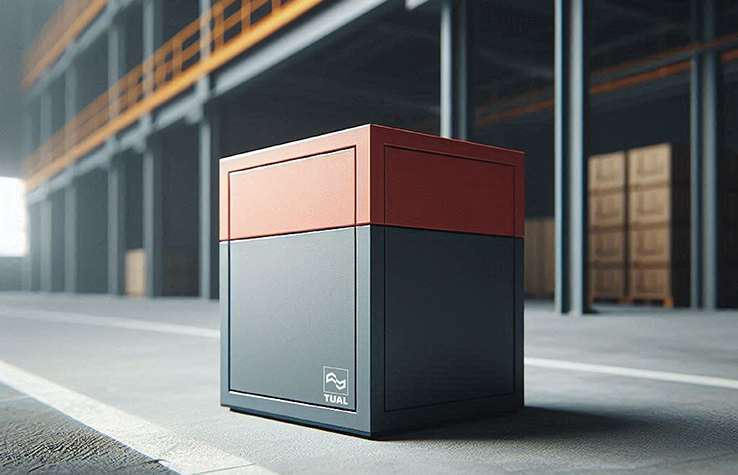
Tual believes it has a solution to these issues with its PowerBank solution. The technology provides DC chargers to a combined charging system (CCS) standard but has an integrated battery energy supply. This allows the Tual’s chargers to operate in places the grid does not go.
Clarke compares the technology to a portable battery used for mobile phones, saying: “You, me, and three billion other people have got used to solving that for ourselves by carrying around a power bank in our backpack, and it means we don’t have to plug into the grid… This is the same idea but with vehicles.”
“They are essentially vehicle batteries” he adds. “Our power electronics and charging are very similar to what you’ll find in any high-end DC charger, with some custom components of our own.”
To create the PowerBank solution, a motorsport provider creates a custom NMC (lithium nickel manganese colbalt oxide) battery pack for on-vehicle batteries. The pack is built to the same spec as the original manufacturer batteries, and it is air-cooled instead of liquid-cooled, making it lighter.
HOW IT WORKS
For ease of use, the lifting pocket on the on-vehicle battery allows for easy changeover by enabling it to be lifted out of the vehicle for charging.
“The PowerBank can be lifted out and put into a secure array in about 90 seconds and you can take a full one and put it back in,” explains Clarke. “It’s not an automated solution, it is an assisted process, but it’s nice and secure.”
Charging speed is also key, meaning there is very limited downtime for the driver. Instead of spending an hour and 20 minutes charging a van, the driver can now have a fully recharged vehicle in under five minutes. Fleets can recharge their battery packs at their depots, where the technology works in a similar fashion.
“Fleets will have an array of power banks, which when they come in will be charged by either a low voltage AC source or any input,” Clarke says. “Batteries are very flexible but on the whole people use 11 or 22-kilowatt-hour input for those batteries.”
Although the batteries recharge slowly, more time is now available for recharging because they are not needed instantly. The aim of the technology is to minimise the driver’s downtime rather than increase the speed of battery charging, and this is what the swappable batteries achieve.
“We all know that people chuck stuff in the back of these vans sometimes, so we need to actively design in as much of that stuff as we can,” Clarke adds.
The battery replacement process is designed to be very basic. Tual has been workshopping with companies to perfect this process. Most locations tend to have staff on-site who are forklift-certified, however a forklift is not always required for the battery to be changed over. The PowerBank cannot be changed by hand as it weighs 260kg.
Clarke expands on the future of the product, saying: “When we have our swap system available it will be a plug-and-play solution.”
The swap system is a mechanical-assisted lift process, similar to a pallet stacker relief system, so the process is relatively straightforward.
STAYING SAFE
The batteries have four layers of defence to protect them against damage. All technology and modules have been certified; even if the battery pack is penetrated, the battery remains safe.
An aluminium case, dubbed ‘The Pack’, houses the battery and is standard to have inside a car. Tual’s aluminium Monobank has an aluminium skin wrapped around it. Finally, a steel frame, named the ‘Vault’, encompasses all of this. In the future, the steel frame may be removed from the battery pack as it increases the overall weight of the product significantly. However, it is reportedly ‘bulletproof’ so it currently serves the battery pack safety requirements well.
“We have designed this so if someone put a cement mixer in the back of a van, drove along and did an emergency stop, it’d be fine,” Clarke says. “What’s more likely is someone has left a power tool sitting on a rack and they haven’t secured that properly. We tend to be talking about small items. The battery pack has more defence than the battery underneath the vehicle itself.”
THE BUSINESS BENEFIT
Tual’s chargers offer a large potential business benefit to fleets, the first being increased productivity. Less time charging means more time on the road, which drastically decreases the amount of time drivers spend at recharging stations and increases time spent on the road. Expensive extensions and upgrades to the national grid can also be forgone using the PowerBank. Upgrades to critical infrastructure are not only expensive but can also create significant downtime for facilities.
Additionally, single vehicle owners can benefit from the technology. Van owners who live in areas where on-street charging is not available can now charge their vehicles overnight using the PowerBank. This reduces the amount of time spent at public chargers and increases flexibility in where the van can be stored. Van owners can park for the night with a nearly depleted van and wake up with a nearly fully charged van, allowing them to get to work straight away in the morning.
Tual has developed a further concept unit that builds on this technology, currently on the AA’s vans. On its ID bus, the AA carries a rescue charger created by Tual which can charge EVs that have run out of power on the road. The charger is a slightly bigger pack and can potentially complete a full recharge as it provides 60kWh. It is the EV equivalent to a petrol can for refuelling combustion vehicles. The recharger works on vans and lorries as well as domestic vehicles.