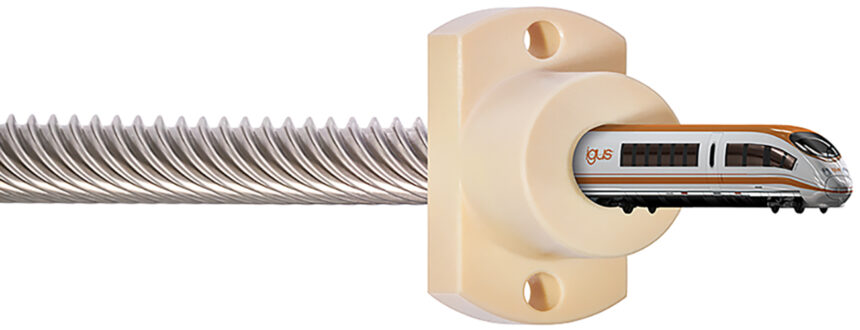
A new lease of life for trapezoidal threads
How one company has given a new lease of life to traditional trapezoidal threads with its innovative thread technology
A key component of mechanical engineering applications for decades, trapezoidal threads convert rotational movement into linear motion. However, even the most reliable technologies have room for improvement, says Robert Day, dryspin product manager at Igus.
“Working at Igus means daring to take an industry standard component and say: It can be even better,” he says. Specialising in motion plastics, Igus initially developed and patented its dryspin thread technology in 1996 as an alternative to high helix pitch threads. Over 50 variations are now available, ranging from matched screws and threaded nuts to dimensions with low pitches for quick one-to-one replacement of old trapezoidal threads.
The company has applied its dryspin technology to trapezoidal threads in order to provide longer service life, improved efficiency, reduced wear and quieter operation to applications. Day and his team have achieved this by optimising the interaction between the leadscrew and polymer threaded nut, resulting in a 30% longer service life and 82% improvement in efficiency.
“You might ask yourself, what difference does the geometry make to a leadscrew, and the answer is quite a lot,” he explains. “The dryspin geometry has flatter thread angles, rounded teeth, and is asymmetrical. The contact surface between the lead screw and the lead screw nut is reduced, which decreases noise and vibration. And, being asymmetrical rather than symmetrical means that we can increase the distance between the thread pitches of the screw, meaning more high-performance plastic and tribologically optimised material can be used in the second part of the lead screw for power optimisation, which reduces friction and wear.”
NEAR SILENT OPERATION
Alongside its durability and efficiency credentials, dryspin leadscrew technology is also quieter than most conventional trapezoidal threads. This is due to the teeth being rounded rather than square, so the contact surface between the threaded nut and the screw is reduced. This leads to fewer vibrations and therefore minuses rattling or squeaking.
“The tighter manufacturing tolerance of the lead screws compared to DIN 103 7e also ensures more precise running behaviour and significantly higher speeds in the application,” Day adds.
SUSTAINABILITY ADVANTAGES
“The seven standard materials we use as lead screw nuts have been optimised to gve us the lowest coefficient of wear and friction possible,” Day continues. “And much like our bearing technology, it depends on the application as to which material and lead screw option is best suited to our customers.”
Not only does dryspin offer mechanical advantages over traditional lead screws, but it also delivers sustainability wins too, he says.
“Both parts of the lead screw are fully recyclable,” he explains. “The screws are also lubrication-free which means they require no maintenance and have a much longer life than traditional options. This means that we’re minimising waste, producing less parts, and reducing our carbon footprint.”
The dryspin screw technology also enables sustainability benefits within the lifecycle of products, too. “The leadscrews are also lightweight, so in a car for instance we are lowering the weight of parts that go in it and therefore helping to reduce the carbon footprint of those applications.”
MANUFACTURING CAPABILITIES
Igus manufactures its lead screws using three methods. For standard products, the firm opts for injection moulding. For special parts or to customise a part to a customer’s design, CNC machining is another port of call. Thirdly, for rapid prototyping or proof-of-concept applications, the company can 3D print parts to aid in the design and specification of the lead screw system.
“Customers can input their application details, such as loads, speeds and so on, and our system will tell them the best material and pitch size for the application, as well as the predicted lifetime of the part and the drive requirements,” Day adds. “Once the customer has specified and designed the part, the details can be uploaded to our online shops where they will be provided with instant pricing and fast checkout. With our online tools, our sustainability and mechanical advantages, dryspin has been successful in many industries.”
ON THE RAILS
“One industry we have had a lot of success with our dryspin technology is the railway industry,” Day says. “Rail manufacturers need a reliable, robust solution that requires minimum maintenance, so with the help of our online design tools and our expert system, we are able to specify to correct parts to ensure they have a robust product that is reliable and has a predictable lifetime.”
In particular, dryspin technology has been successfully applied to improve a leading rail operator’s sliding step mechanism. Traditional sliding step mechanisms – which bridge the gap between the train and the platform to ensure safe boarding and alighting for passengers – often face problems such as sticking, misalignment and high maintenance costs. The use of Igus’ dryspin lead screw drives paired with its iglidur J nuts enabled the system to function without fault despite high temperature fluctuations and exposure to dirt and moisture. The simplified guidance system eliminated sticking while the maintenance-free design reduced life cycle costs.