Software specialist Flow Science has launched its new Flow-3D 2025R1 product family, bringing additive manufacturing (AM) and laser welding process modelling abilities to users.
The product family now includes Flow-3D AM and Flow-3D Weld, and includes several additions to Flow-3D CFD simulation capabilities to enhance the software’s functionality, full HPC support, and ease of use.
“With the integration of Flow-3D AM and Flow-3D Weld into the Flow-3D product family, we’re putting advanced manufacturing simulation tools into the hands of practicing engineers,” said John Wendelbo, Flow Science president. “These are highly accessible but also extremely accurate solutions. And with scalability and automation capabilities, you have something truly state-of-the-art.”
Billed by the company as a “breakthrough in AM simulation technology”, Flow-3D AM 2024R1 delivers a fully-integrated simulation platform for laser-based AM processes such as powder bed fusion (PBF) and directed energy deposition (DED). The software offers a new unified user interface and pre-loaded process templates that simplify complex simulation setup. This allows users to easily move between steps in their process simulations while maintaining project continuity.
Flow-3D AM harnesses the capabilities of Flow Science’s Flow-3D Solver software to offer support for high performance computing (HPC) platforms in order to accelerate simulating throughput to up to nine times faster than standard workstation configurations. This allows AM professionals to speed up the time-to-market for critical AM applications. With a dedicated Flow-3D AM node now available in Flow-3D (x), engineers can take advantage of a powerful ecosystem approach which accelerates development cycles and enables comprehensive design space exploration, sensitivity analyses, and process optimisation.
Flow-3D Weld 2025R1, meanwhile, is designed to offer enhanced ease-of-use in precision welding simulation. Featuring improved workflows with a unified user interface, the software provides users with simulation templates, new process automation and analysis capabilities, and substantial performance improvements. Through the new interface, users can enable all relevant physics models within a single application as well as define all required material properties for single or dissimilar metal welding applications. Additionally, the software’s new pre-loaded welding template makers simulation setup easier, while HPC compatibility helps to speed up simulation and time-to-market.
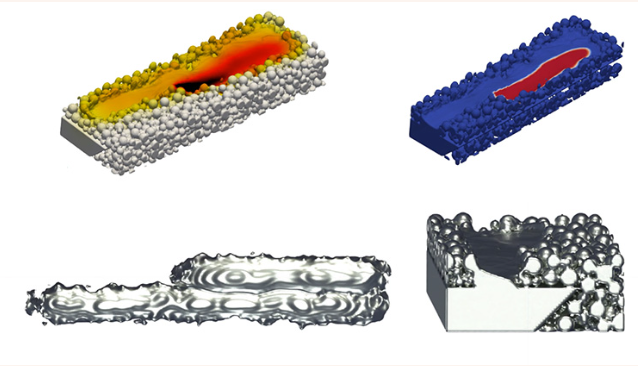
Equipped with a new discrete element method (DEM) model, Flow-3D 2025R11extends particle-particle interaction capabilities for applications such as granular material handling, slurry mixing and particle-laden flows. Flow-3D Cast 2025R1 aids casting engineers in the manufacture of complex non-ferrous castings, thanks to improvements to the software’s solidification and shrinkage, shot sleeve and valve models. Thanks to these developments, the analysis and interpretation of porosity can be simplified and the final location of defects can be predicted more accurately.
The final addition, Flow-3D Hydro 2025R1, introduces a new DEM model which allows users to account for particle-particle interactions such as collision and friction, providing utility beyond that of the standard Lagrangian particle model. The DEM model provides insights into the stability of rocks in different flow conditions, opening up possibilities for cost savings and risk reduction for unique protection systems on riverbanks and other structures. Users can also benefit from insights into grit separation systems, stormwater separators and other granular flow scenarios.