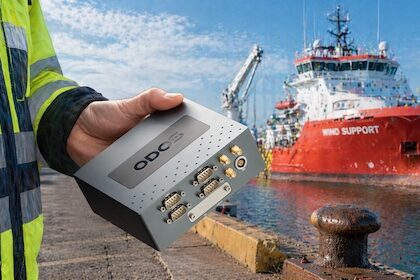
A global maritime and logistics operator has strengthened operational visibility and predictive maintenance capabilities across its hydrogen-powered fleet with ODOS remote monitoring technology
The rollout is part of the organisation’s decarbonisation strategy as its hydrogen-powered fleet and supporting infrastructure continue to expand across international operations.
As hydrogen-powered operations scale across multiple countries and operating environments, maintaining consistent, high-quality operational data is becoming increasingly complex. Monitoring assets under real-world conditions requires scalable logging and analysis infrastructure that can support operational reliability and ongoing engineering development.
To address this, the organisation implemented ODOS’ modular monitoring portfolio across a range of hydrogen-powered assets, including vessels, trucks, generators, and auxiliary equipment.
The deployment combines an ODOS portfolio of logging and monitoring technologies, including Megalog, Microlog, Minilog, and Decalog Fleet Logger systems, enabling monitoring to be tailored according to asset complexity, operational requirements, and cost considerations. The platform also provides centralised operational visibility across a diverse international hydrogen-powered fleet.
For high-complexity maritime applications, the ODOS Megalog can capture high-frequency data across multiple engine channels alongside hydrogen system parameters, providing detailed operational insight into real-world performance behaviour and helping teams to identify performance degradation and system anomalies at an early stage.
Lower-complexity or cost-sensitive applications, such as trucks and auxiliary equipment, use the ODOS Microlog platform to deliver streamlined, scalable monitoring while maintaining operational efficiency across the wider fleet.
Operational data from all deployed assets is securely transmitted through a centralised data pipeline and REST API into the organisation’s internal fleet dashboard to provide near real-time visibility across hydrogen-powered operations.
The ODOS cloud platform also acts as a secure device-management layer, facilitating remote configuration, over-the-air firmware updates, and continuous optimisation of deployed logging systems without requiring physical access to assets.
The deployment reinforces the link between operational data and engineering development. By correlating field performance data with laboratory and test-cell results, engineering teams can enhance calibration accuracy, validate system behaviour, and support continuous optimisation of hydrogen propulsion technologies.
A key outcome has been the earlier identification of potential performance issues before conventional alarm thresholds are triggered, enabling a more predictive approach to maintenance planning, reducing unplanned downtime and improving fleet reliability.
All hardware was deployed across multiple international locations and configured to operate under varying climates, duty cycles, and operational conditions. ODOS worked with the operator’s engineering teams to define key performance indicators and alert thresholds aligned with real operational priorities.
The chief engineer at the organisation said, “ODOS has been instrumental in providing monitoring solutions across our hydrogen fleet. The loggers give us real-time visibility, helping us detect issues before they become problems and enabling our engineering teams to optimise performance. Working with one supplier across a diverse range of assets has significantly simplified our operations and supported our decarbonisation goals.”
Umesh Patel, business director at ODOS Solutions, said, “As hydrogen-powered fleets continue to scale globally, operators need far greater visibility into asset performance and system behaviour under real-world operating conditions. Scalable remote monitoring infrastructure is becoming critical not only for operational reliability, but also for supporting the safe and efficient scaling of hydrogen technologies across the transport sector.”