Sweden’s power sector is set for further renewable-led expansion, supported by industrial electrification, green hydrogen development, battery manufacturing, data centres, and wind investment
GlobalData, an intelligence and productivity platform, has highlighted that constrained transmission between generation-rich northern Sweden and demand centres in the south risks limiting the value of new capacity and widening regional electricity-price differences.
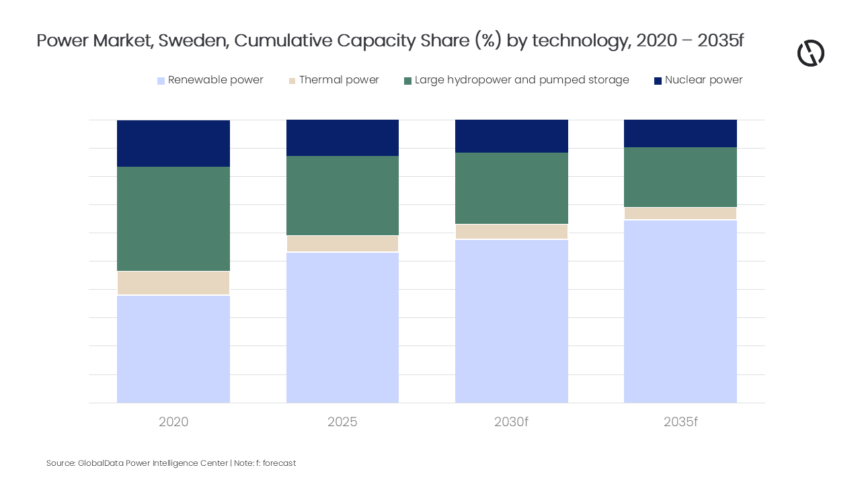
GlobalData’s latest report, “Sweden Power Market Trends and Analysis by Capacity, Generation, Transmission, Distribution, Regulations, Key Players and Forecast to 2035,” found that the country’s installed power capacity will grow at a compound annual growth rate (CAGR) of 2.9% between 2025 and 2035. Renewable technologies will account for a growing share of the national fleet, led by wind power and solar PV, while hydro and nuclear continue to provide the low-carbon generation base underpinning the system.
Attaurrahman Ojindaram Saibasan, Power analyst at GlobalData, said, “Sweden starts from a strong position, with hydro and nuclear power providing a largely fossil-free electricity base and wind power supplying much of the incremental growth. The next phase of the market will be shaped by demand as much as supply. New electricity-intensive industrial projects, including fossil-free steel, battery manufacturing, hydrogen production, and data centres, are increasing the importance of reliable power delivery in the locations where demand is emerging.”
The central challenge is geographical: Sweden’s northern bidding zones hold substantial hydroelectric and wind resources, while industrial demand, electricity consumption, and much of the country’s population are concentrated in the south. Limited north-to-south transmission capacity can cause congestion, constrain renewable generation, and leave southern consumers exposed to higher prices despite a national electricity surplus.
Saibasan added, “Grid investment is a critical enabler of Sweden’s power transition. Without faster delivery of transmission upgrades, northern clean power surpluses may be curtailed or exported while southern industrial users face tighter supply and elevated price volatility. Svenska kraftnät’s transmission expansion plans will therefore be as important as generation investment in determining whether Sweden can convert its resource advantage into dependable, competitively priced electricity.”
Offshore wind represents a major long-term opportunity; however, project delivery depends on progress in maritime spatial planning, defence approvals, environmental assessments, seabed access, and grid connection arrangements. Additionally, onshore wind and solar PV will continue to play an important role in expanding supply, particularly where projects can secure viable connection capacity and long-term offtake agreements.
Sweden’s policy framework supports a fossil-free electricity system and economy-wide net-zero emissions, while the planned wind-down of the electricity certificate scheme changes the support landscape for new renewable projects. The government’s nuclear roadmap also signals a renewed role for nuclear generation as a source of long-duration, firm, low-carbon capacity.
Saibasan said, “Sweden has the generation resources, industrial demand base, and market structure to remain one of Europe’s most important clean power markets. Delivering that opportunity will require aligned decisions on permitting, grid reinforcement, offshore wind development, and the financing framework for new nuclear capacity. The policy test is not simply to add more capacity, but to ensure that clean electricity can reach consumers when and where it is needed.”