
“The future will be shaped by AI-based control of the electric drivetrain”
When contemplating the future drivetrain, Dr Otmar Scharrer says that one thing in particular is becoming apparent: “The major trend is to include more parts and more features within the drivetrain,” he begins. Interestingly, he also firmly acknowledges the enabling role of AI in allowing companies such as ZF, where he is head of development for electric mobility, to respond to this trend. “There is nothing without AI: the future will be shaped by AI-based control of the electric drivetrain,” Scharrer emphasises
Following a long career with the likes of Mahle, General Motors and AVL, Scharrer joined ZF in 2020. He describes his work today as being focused on “smart platforms for smarter mobility; a neuronal approach to powertrain innovation”. And, as Scharrer explains, this work can be illustrated by three recent advances from ZF that fall under this banner.
The first innovation is the Select e-drive platform, wherein ZF addresses the market for pure electric drive technology. Scharrer describes this as “an inverter platform for volatile markets” – which is a good indicator of how ZF’s approach to future tech is being informed by current geopolitical and supply chain issues.
The new platform is designed as an all-in-one solution, comprised of modular kits for e-machines, power electronics, reduction gears and control software for e-drives. Clearly defined interfaces between components and the overall system simplify integration and production. The platform’s modular construction kits have been designed in a way that ensures ZF can develop commercially attractive complete systems and play a leading role as a component supplier. Integrating four functions in one product reflects an important trend in drivetrain evolution. Ultimately, states Scharrer: “This high level of integration is a gamechanger for the next generation of charging solutions. And the smart combination of electric drive and brake is the future.”
TEMPERATURE CONTROL
The second future-focused launch from ZF is a new thermal management system, TherMaS, which the company says increases range by up to 10%. Highly efficient thermal management systems can extend the range of battery-electric and plug-in hybrid vehicles without the need for more expensive drivetrains or larger batteries. “The battery of an electric car in particular is very sensitive when it comes to its ideal operating temperature. It feels most comfortable between 15 and 25°C,” explains Scharrer. The ambient temperature therefore has a major influence on the effective range of an electric vehicle. This is because on extremely cold or extremely hot days, the thermal management system is under greater strain, which leads to higher power consumption which can almost halve the available range. “Improving thermal management is therefore of great benefit to both the manufacturer and the driver,” observes Scharrer.
As another highly integrated system, ZF says that TherMaS is lighter and smaller than comparable variants, yet is more efficient and cost-effective. Using propane as a refrigerant results in better cooling performance, as well as a smaller and lighter system design. Commenting on this trend for smaller, lightweight solutions, Scharrer says simply: “Anything that can be left out will be left out”.
PROOF OF CONCEPT
The third area of focus for Scharrer and his team is in hybrid solutions, where their interest lies in adapting to market dynamics by delivering greater flexibility. As the market for electrified passenger car drives evolves rapidly and hybrid solutions regain momentum, ZF is expanding its portfolio to meet growing demand. “Our approach here is illustrated by our new hybrid transmission concept ‘8HP evo’ with improved efficiency and performance,” details Scharrer.
This concept is based on ZF’s successful eight-speed automatic transmission. The new 8HP evo offers efficient and flexible performance for various hybrid platforms. From the outset, the current generation was designed according to the modular principle to support both conventional combustion engines and hybrid models. With the 8HP evo concept, ZF has improved the electrification and efficiency of the transmission. Improvements to the electric motors and power electronics are the main contributors to this – including software-side function updates that further exploit the potential. “The experience gained from our pure e-drive solution has been incorporated into these upgrades to our established benchmark product,” notes Scharrer.
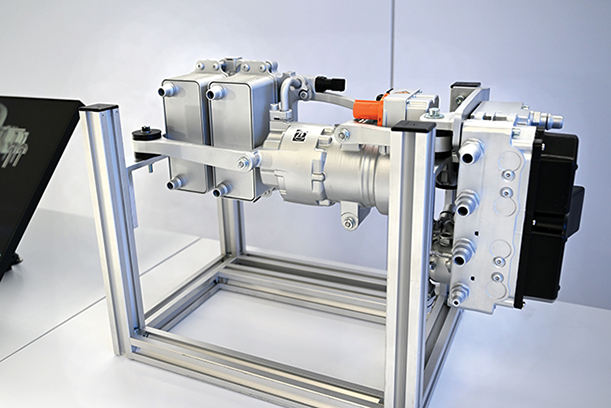
An additional highlight of ZF’s hybrid approach can be found in its electric range extender systems for battery-electric platforms. The company is currently working on the next generation of these systems; the electric Range Extender (eRE) and the electric Range Extender plus (eRE+). Both variants are a highly integrated design that is flexible in terms of performance, electronics architecture, 400 volts or 800 volts and semiconductor type. The eRE combines an electric motor as a pure generator with an integrated inverter and a planetary gearbox. The system is controlled by ZF software. The eRE+ also has an intelligent clutch and a differential. This allows the electric motor to be used not only as a power generator, but also as an additional secondary drive, which enables manufacturers to temporarily use electric all-wheel drive without installing an additional electric motor. Power can be scaled for both models. “This modular platform approach allows us to respond to dynamic market and manufacturer requirements,” comments Scharrer.
In terms of how these drivetrain developments will be brought to market, Scharrer acknowledges that the future will likely be the same as the present: new technologies join the market in the premium segment and then gradually get rolled out to the mass market as they become cheaper. “I think the art of engineering will now be to connect these two worlds. To be as cost efficient as the compact class but to be equipped with features from the luxury sector,” Scharrer comments.