Generative design has moved from an experimental capability to a core engineering tool
Generative design has moved rapidly from an experimental capability to a core engineering tool, driven by advances in artificial intelligence, machine learning and cloud-native platforms
Recent announcements from Dassault Systèmes, Autodesk and Siemens highlight how generative approaches are now being embedded across mechanical CAD, manufacturing, and electronic design automation (EDA), fundamentally changing how engineers create, evaluate and optimise designs.
While early generative design tools focused on topology optimisation or automated concept generation, the latest developments point to a broader transformation: AI systems that actively participate in engineering workflows, generate editable geometry, automate verification, and integrate design intent across disciplines.
GENERATIVE AI ENTERS MAINSTREAM CAD
Dassault Systèmes’ release of Solidworks 2026 marks a significant step in normalising generative AI within everyday mechanical design workflows. Rather than positioning generative design as a specialist function, the new release embeds AI directly into drawing creation, detailing and assembly modelling.
A notable enhancement is AI-assisted assembly creation, where the system automatically recognises components that resemble standard fasteners – such as bolts, nuts and washers – and assembles them accordingly. This capability reduces manual modelling effort, improves consistency, and minimises common assembly errors, particularly in large mechanical systems.
Generative AI is also being applied to drawing creation, accelerating detailing and documentation while improving traceability. By automating repetitive drafting tasks and linking changes directly to evaluated attributes, Solidworks 2026 supports more robust change management, an area where manual processes have traditionally introduced risk.
Beyond geometry, Dassault has introduced an AI-powered virtual companion designed to extract and summarise engineering knowledge from community forums, wikis and internal documentation. For design engineers working under schedule pressure, this represents a shift toward context-aware assistance embedded directly in the design environment, reducing the friction between problem identification and resolution.
Although these features may appear incremental, they reflect a broader trend: generative AI is being used not just to create new forms, but to compress design cycles, reduce cognitive load and improve collaboration across distributed engineering teams.
FROM TEXT PROMPT TO EDITABLE GEOMETRY
If Solidworks 2026 represents generative AI augmentation, Autodesk’s announcements at Autodesk University 2025 (AU2025) signal a more radical rethinking of CAD itself. Autodesk has been investing heavily in AI across its three industry clouds – Forma (construction), Flow (entertainment) and Fusion (manufacturing) – with generative capabilities native to
each platform.
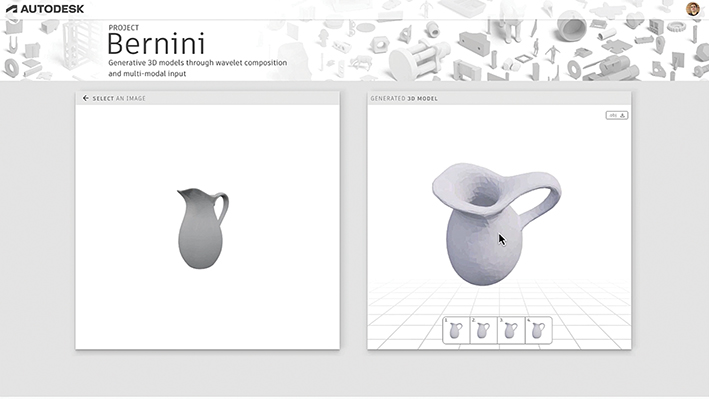
The most disruptive development is Autodesk’s work on Neural CAD, an AI foundation model capable of generating fully editable CAD geometry from a single text prompt. Built on Autodesk’s proprietary manufacturing-focused models and originating from the company’s Project Bernini research (covered in our April 2025 issue), this approach moves beyond generative suggestions to true geometry creation within the CAD kernel.
Unlike earlier generative design tools that produced optimisation outputs requiring reinterpretation, Neural CAD aims to deliver parametric, editable models that engineers can immediately refine. In demonstrations, Autodesk showed how a simple prompt could generate a baseline air fryer design, which could then be modified using standard CAD operations.
For professional engineers, the implication is significant: concept generation, traditionally a time-intensive and experience-driven phase, could be accelerated dramatically. However, Autodesk has emphasised that engineers remain “in the loop,” acting as evaluators and decision-makers rather than passive recipients of AI-generated designs. The intent is not to replace engineering judgement, but to expand the design space and lower barriers to participation.
Autodesk has also focused on practical integration. Fusion’s generative capabilities connect directly to manufacturing toolpaths, PLM workflows and even external platforms such as Microsoft 365, enabling downstream reuse of design data for visualisation, documentation and communication.
GENERATIVE DESIGN BEYOND MECHANICS
In electronic design automation, meanwhile, Siemens’ Solido software illustrates how AI-driven optimisation is becoming critical for advanced semiconductor design, particularly in analogue, RF and reliability-critical applications.
Certus Semiconductor’s adoption of Solido for IO and ESD library development highlights a parallel evolution in EDA. Instead of manually iterating across thousands of process, voltage and temperature corners, Solido applies machine learning to accelerate design space exploration, variation-aware verification and IP characterisation.
For analogue and mixed-signal engineers, this represents a generative approach at the circuit level: AI models predict performance trends, identify corner-case failures and optimise designs while maintaining SPICE-level accuracy. This is especially relevant at advanced process nodes, where variability, reliability and compliance requirements are increasingly difficult to manage using traditional methods.
The deployment of AI-powered Solido workflows across major foundries underscores a key point: generative design is as much about verification and optimisation as it is about geometry creation. In safety-critical sectors such as automotive, aerospace and industrial electronics, AI is being used to increase confidence and reduce time-to-qualification without compromising reliability.
COMMON THEMES
Across mechanical CAD, manufacturing and EDA, several common themes emerge. First is the rise of domain-specific foundation models – AI systems trained not just on generic data, but on engineering-specific representations, constraints and physics. This specialisation is critical for reducing errors and ensuring outputs remain physically and functionally meaningful.
Second is the emphasis on IP protection. Autodesk, for example, has highlighted safeguards that discard generated outputs resembling training data, ensuring customer IP is not inadvertently reproduced. As generative design becomes more pervasive, trust in data governance will be essential for adoption in commercial engineering environments.
Finally, all three companies stress the continued role of the engineer. Whether through editable Neural CAD models, AI-assisted drafting or ML-driven circuit verification, generative tools are positioned as collaborators rather than autonomous designers.