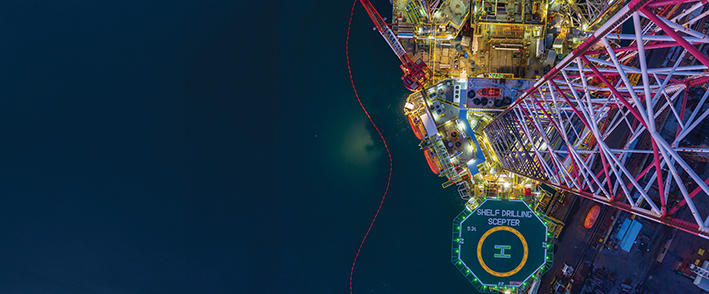
Offshore oil and gas installations have always been complex and the digitalisation of operations adds a new layer
Offshore oil and gas installations have always been complex. Today, the digitalisation of operations and rising electrification add a new layer. Platforms that once relied mainly on mechanical systems now contain thousands of kilometres of cabling for automation, control, and safety.
These advances improve efficiency but introduce a critical challenge: maintaining fire, gas, and watertight integrity in structures carrying unprecedented cable volumes. Penetrations through bulkheads and decks, often treated as minor details, can become weak points if not engineered to the same rigour as other safety systems.
THE RISING TIDE OF CABLE DENSITY
A generation ago, the number of electrical and communication cables on a platform was far lower. Today’s facilities demand advanced instrumentation, redundant control systems, subsea tie-backs, and digital monitoring, all driving cable counts higher. This density creates engineering headaches. Penetrations must accommodate power, fibre optic, and hybrid cables with different diameters and bending radii. At the same time, regulations demand resistance to fire, blast, and pressure. Methods developed for lower volumes and less diversity are increasingly insufficient.
The challenge is not only the number of cables but also late design changes. During project phases, modifications often require new penetrations. Systems must therefore provide flexibility without compromising safety.
SAFETY AND COMPLIANCE PRESSURES
Industry standards such as IMO 754(18), IEC 60092, and national offshore rules impose strict requirements on passive fire protection. Penetrations are tested under conditions simulating hydrocarbon fires, explosions, and water ingress. Yet, incidents continue to show vulnerabilities. Fire can spread rapidly along cable routes if seals fail, while compromised watertightness threatens floating stability. For operators, robust sealing is not just about compliance but about risk reduction.
Designers therefore seek solutions that are demonstrably tested, modular enough to handle variations, and maintainable across decades of service.
ADVANCES IN MODULAR TRANSIT TECHNOLOGY
Recent developments focus on modular sealing systems able to adapt to growing cable volumes without loss of performance. These typically employ pre-engineered blocks and frames, allowing different diameters to be sealed within one penetration.
Key advances include:
- Improved materials: High-performance compounds able to resist hydrocarbon fire and long-term exposure.
- Simplified installation: Systems designed for straightforward assembly reduce human error offshore and allow later reconfiguration.
- Lifecycle reliability: Designs maintain performance under vibration, saltwater, and mechanical stress.
These innovations move the industry away from bespoke, site-specific solutions toward standardised, test-certified components that give engineers greater confidence.
DESIGN FLEXIBILITY AND DIGITAL TOOLS
Another important trend is the use of digital design tools for penetration planning. With hundreds of transits on a large installation, manual coordination is error-prone. Software now allows designers to model each penetration in 3D, ensuring every cable is accounted for and sealed before construction. Spare capacity can also be tracked, supporting future expansions
and retrofits.
The result is better accuracy and fewer costly modifications during commissioning. In an era where overruns face heavy scrutiny, visualising cable management early is increasingly valuable.
BEYOND COMPLIANCE: RESILIENCE AND RELIABILITY
The industry’s energy transition adds further pressure. Hybrid facilities combining hydrocarbons with renewables demand extensive electrical integration. Hydrogen, carbon capture, and offshore wind connections all rely on reliable cable and pipe transits. In this context, sealing solutions are not just regulatory necessities. They underpin the resilience of entire installations, safeguarding people and assets against escalating risks.
Operators that invest in proven, modular systems benefit from safety assurance and lower lifecycle costs, since transits can be adapted without wholesale replacement.
RISING TO THE CHALLENGE
As platforms evolve into more digitalised and electrically complex systems, the challenge of managing cable penetrations cannot be underestimated. Once regarded as minor details, they are now central to overall safety.
Advances in modular systems, improved materials, and digital planning tools are helping engineers meet the dual pressures of compliance and operational flexibility. By addressing cable density challenges with the same rigour applied to other safety-critical systems, the offshore sector can create installations that are compliant, resilient, and prepared for the future.
Ola Johansson is communications and media manager at MCT Brattberg. For more information visit: www.mctbrattberg.com