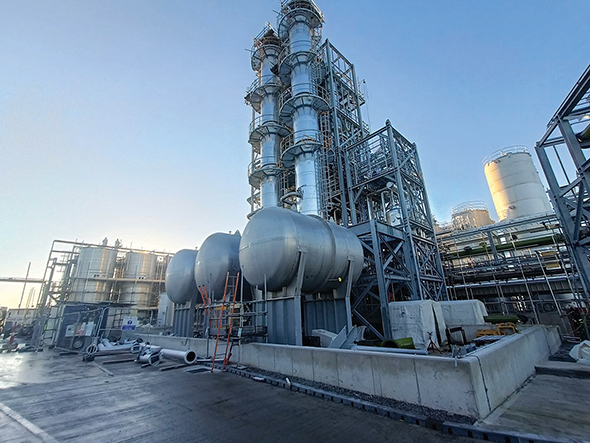
Demand for sustainable recycled products has kick-started a growth in solvent recovery capacity
The push for emission reduction and recycled products has led waste treatment specialist Veolia to increase its capacity for recycling of used solvents, waste paint thinners and solvent based paint to 86,000 tonnes a year to meet the growing demand for more sustainable industrial products.
The company has expanded its facility, at Garston in Liverpool to create new products as an alternative to virgin solvents, to enable reuse in industries like pharmaceuticals, semiconductors, paint, agrochemicals and cement manufacture.
What is solvent recycling?
Solvent recycling is the process of recovering and reusing processed solvents. It is used for a variety of products including hand sanitiser, alcohol, and other solvent-based solutions. Solvent waste can be altered back into a virgin-like solvent and the process reduces the volume of hazardous waste.
Solvent recovery methods
There are various distillation processes used to recover solvents. Distillation involves the conversion of a liquid into a vapor through boiling and condensing the substance back into liquid form through cooling. The following are the best-known methods:
1) Simple distillation – the separation of a liquid from a solid-liquid solution. The process, used for mixtures containing one volatile component, is energy efficient and cheaper than other options.
2) Fractional distillation – a popular method that separates a liquid from a solution of two or more mixable liquids. Fractional distillation is able to separate mixtures into high-quality recycled solvents.
3) Flash distillation – this heats liquids to the same boiling point and separates the solvent from residue, for use in paint manufacture. Veolia uses this method then transports organic residues to a specialist facility to be blended into secondary liquid fuel, used as an alternative to fossil fuels for cement and lime kilns.
4) Steam and vacuum distillation – these are other techniques used within the solvent recovery process. Steam can generate organic solvent-free products and vacuum distillation helps distil heavier objects and volatile compounds.
Veolia uses a combination of methods including flash and fractional in a multi-stage operation. All loads are sampled and analysed on site as they arrive to check compliance, followed by the distillation process which transforms the liquids into new products for industry use depending on the liquid type.
Thin film evaporator
The company also uses a ‘thin film evaporator’ to separate the components of a process liquid based on volatility. The basic method involves applying heat to a liquid which causes it to evaporate, thereby leaving the less volatile substance behind. The more volatile, and now gaseous, substance is then condensed and collected at a separate location.
Traditionally, batch or continuous processes such as natural/forced circulation, falling and rising film, and climbing and falling plate evaporators have been used successfully with a range of process liquids. However, these evaporators have proven to be inefficient with high-boiling, viscous, fouling, and heat sensitive liquids.
The company claims that this solvent recovery process will save an estimated 172,000 tonnes of CO2e in greenhouse gas emissions each year, equivalent to taking 78,000 diesel cars off the road annually.
The energy centre in Garston uses a distilled product fuel, produced on site, to power the steam boilers, reducing the energy required from gas by 10,000 MWh per year, equivalent to the gas usage of 1,000 homes per year.
Veolia’s strategic plan
The expansion is part of the facility’s new strategic plan called GreenUp which aims to make Veolia a champion of decarbonisation, de-pollution and regeneration of natural resources.
The site processes waste materials to regenerate them into high-quality recycled products that can be reused, thereby displacing virgin materials in the supply chain.
Fuelled by recycled materials
As well as generating recycled products, the plant also produces several types of fuel. As mentioned, a distilled product fuel is used instead of natural gas to power the site’s steam boilers.
Other by-products from the process are sent to Veolia facilities to be manufactured into alternative fuels for use in the cement industry, helping to decarbonise this industry and reduce the reliance on fossil fuels.
The increased processing capacity has been achieved by installing new distillation columns to separate liquids, and 17 tanks to store or transfer the solvents. Transport is handled through two new high throughput tanker loading bays which manage logistics for processing and loading the recycled solvents ready for customer delivery.
said: “This latest expansion of our solvent treatment capabilities demonstrates our commitment to deliver high quality recycled products derived from advanced waste treatment,” said Nicola Henshaw, managing director Hazardous Waste at Veolia UK.
“By preserving resources, reducing reliance on virgin materials, and delivering sustainable products to support manufacturers, we can also create major carbon savings.”
For more information visit: www.veolia.co.uk.