Rounding up the latest additive manufacturing research breakthroughs in robotics and adaptive materials.
While recent years have seen the global additive manufacturing industry shift its focus towards industrialisation, the importance of research and development (R&D) projects remains crucial in opening up new possibilities and applications for the technology.
Research spending in areas such as defence and AI, for instance, have increased significantly in the last few years. Private investments in start-ups and spin-outs continue to scale up, too, as the industrial case for many of these technologies strengthens.
Here, we take a look at some of the latest innovations in additive manufacturing R&D across the globe.
MINI DRONES
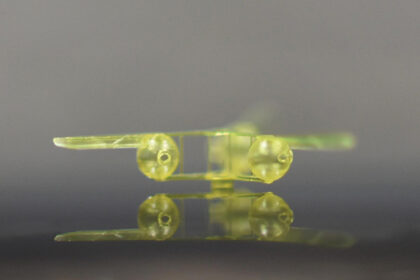
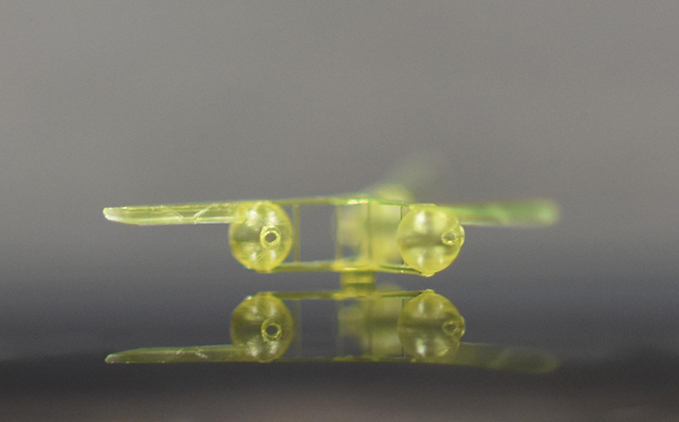
EPFL engineers have designed acoustic cavities that convert sound waves into thrust, propelling small robots and ultralight aerial vehicles without on-board actuators or electronics. The team in EPFL’s MicroBioRobotic Systems (MICROBS) Lab harnessed the physics behind the Hemholtz resonance phenomenon, which occurs when airflow passing across an opening causes air trapped inside a cavity to oscillate back and forth.
“Instead of pushing devices around with sound waves, we have created acoustic resonators that are tuned to harness sound at specific frequencies to generate directional thrust and controlled motion,” says lab head Selman Sakar. “Our work shows the feasibility of transforming a simple, cleverly designed mechanical piece into robotic matter.”
Using a 3D nanoprinting technique, the team built ‘microfliers’: ultralight flying vehicles with three microscopic cavities integrated directly into their polymer structures. One design weighing just 150 micrograms used its cavities to generate direct upward thrust like a rocket. Another microflier combined the cavities with tiny blades, which spun at speeds of up to 13,000 revolutions per minute, to generate stable, helicopter-like aerodynamic lift.
Because the devices rely on hollow cavities rather than motors, gears, or magnetic components, they can be made extremely small and lightweight using a variety of 3D-printing methods.
“Our concept is compatible with even further miniaturisation, enabling advanced designs that push the boundaries of robotics and aeronautics,” says first author and MICROBS Lab PhD student Junsun Hwang.

ENERGY-EFFICIENT ROBOTS
Elsewhere, Researchers at Seoul National University of Science and Technology have developed 3D-printed porous foot pads for walking robots that reduce battery power consumption by up to 6.2%. The foot pads use triply periodic minimal surface (TPMS) metastructures, lightweight porous geometries that compress on impact and spring back during push-off, storing and releasing mechanical energy with each step.
Tested on a commercially available quadruped robot, the system delivered power savings between 1.4% and 6.2% across walking speeds from 0.4 to 1.0m/s, while the robot maintained stable locomotion throughout. The TPMS geometry has already found use in airless tires and soft robotic grippers. The researchers say this application could help produce quieter, longer-running quadruped robots for indoor service, inspection, and logistics deployments.
ADVANCING ADAPTIVE MATERIALS
Adaptive materials – engineered substances that automatically alter their physical properties when exposed to external stimuli – are receiving ever-growing attention in the research space.
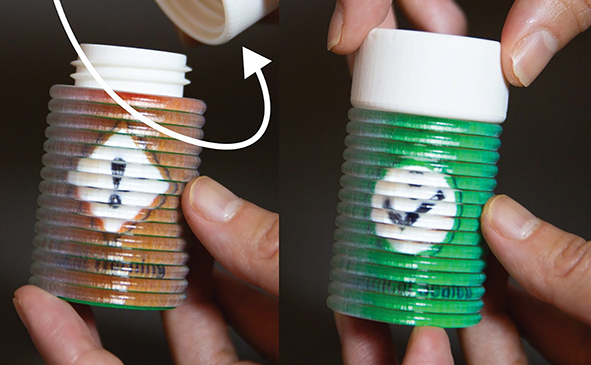
MIT’s ongoing work in this area has yielded two recent notable breakthroughs. The first centres around the development of a 3D printing system that produces objects capable of changing their surface appearance in response to physical interaction, without the need for electronics. Called ShiftLens, the system enables printed objects to display different images or patterns when a user presses, slides or turns part of the object.
“With our system, an object can tell you whether you are using it properly, without the need for sensors or any complicated electronics,” says Yunzi Zhu, MIT graduate student and lead author of the paper. “The interactive display is mechanical, so you can create a self-contained, multistate, interactive device that a user an control very intuitively.
Zhu’s team demonstrated ShiftLens through a chemical bottle that turns green and displays a check mark when its cap is tightly secured, then turns red and shows an exclamation mark when it’s loose. Potential applications include industrial piping that could visually flag a damaged connection, or outdoor warning signs that don’t rely on fragile electronic circuits.
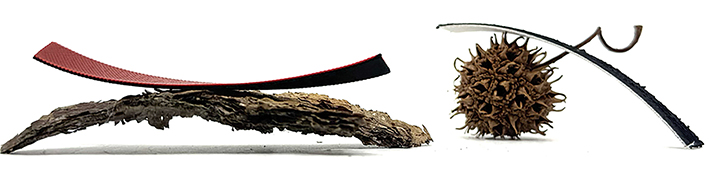
Another MIT team recently 3D printed a thermal twisting actuator based on the humidity response mechanics of a pine cone. The work extends more than a decade of category-theory research in corresponding author Markus Buehler’s lab, including earlier categorical prototyping that preserved selected molecular-scale mechanics in large 3D printed parts. According to the research team, this pipeline closes the remaining gap from multiscale biological mechanics through an engineered realisation and fabrication specification to an experimentally validated, machine-executable design.
Meanwhile, researchers from Pusan National University in South Korea have developed what they claim is the first 3D printable smectic liquid crystal elastomer ink capable of switching molecular alignment during printing, allowing a single printed filament to elongate or contract when heated. The team lists soft robotic actuators and artificial muscles, reconfigurable surfaces for haptic display, and adaptive textures that regulate aerodynamic drag as real-world applications.
And elsewhere, a Heidelberg University team has designed a light-curable 3D printing polymer that a chemical trigger can take apart at room temperature. As such, printed parts can be broken down into their molecular building blocks in seconds, and then recovered and printed again with the same composition and mechanical properties. The team is targeting vat photopolymerisation methods such as digital light processing that turn liquid inks into fine, light-cured parts for personalised medicine and soft robotics.
Read the October issue of International Design Engineer magazine here, or visit our magazine archive for all our recent publications.