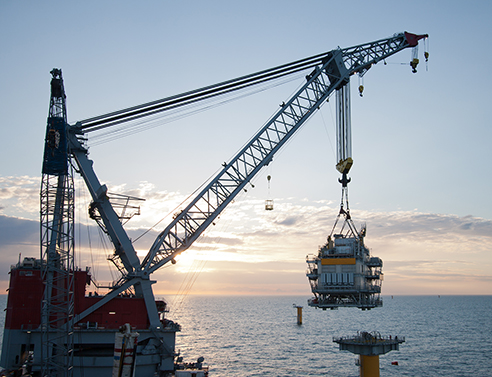
In the oil and gas industry, a relatively small component can have a significant impact on a much larger operation. Lifting, pulling, securing, towing and subsea activities all depend on reliable connections between loads and equipment. When an operation takes place offshore, in a confined space or hundreds of metres below the surface, the requirements placed on these connections become even more demanding.
The hardware required to support these operations is therefore remarkably diverse. From shackles and hooks to sockets, chain fittings and specialised subsea equipment, each application can bring its own combination of loads, dimensions, accessibility and environmental conditions. For engineers, selecting the right component is more than checking if a product is suitable for a particular application. Geometry, handling, safety, durability and availability can all influence whether a product is suitable for a particular application.
When availability becomes part of the equation
In the oil and gas industry, time is rarely a neutral factor. Offshore projects involve vessels, crews, specialised equipment and carefully planned operations. If a relatively small component is unavailable, a much larger operation can potentially be delayed. The cost of downtime can quickly exceed the value of the component itself.
This makes product availability an important consideration when specifying lifting and rigging equipment.
Maintaining availability across a broad product portfolio presents a considerable logistical challenge. A supplier needs to stock not only commonly used lifting components, but also specialised products for demanding applications, including subsea operations and heavy lifting.
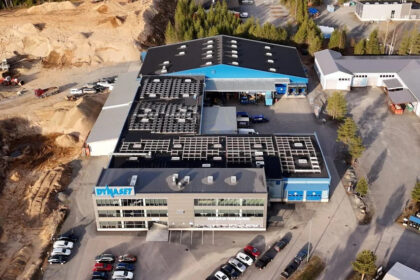
Green Pin has therefore placed considerable emphasis on maintaining high stock levels across its entire product range and building a global distribution network. With more than 1000 distributors worldwide, products can be delivered virtually anywhere in the world within 72 hours.
For an engineer or project team, this means that technical suitability does not have to be considered separately from practical availability. The right component also needs to be accessible when the operation requires it.
Engineering around real-world constraints
Innovation in rigging and lifting does not always mean developing a completely new product category. Sometimes the most useful innovation comes from identifying a specific limitation in an established product and redesigning it around the way it is actually used.
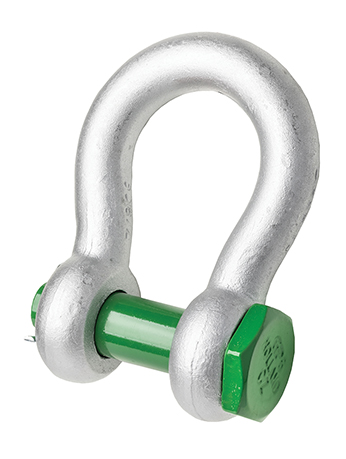
A good example is the newly developed Green Pin Bow Shackle SCP. A standard bow shackle with a slimmer screw bolt and cotter pin. The two components form a double-safety principle for this ‘slim shackle’. The screw bolt enables quick assembly and disassembly, while the cotter pin provides a second mechanical safeguard against unintended opening.
The compact design of the slim shackle also addresses another practical challenge: restricted access. With a slimmer screw bolt that sits within the width of the shackle body, the design creates a clean and compact profile that is less likely to snag and easier to handle in confined spaces.
The idea for the product came from Aleksandr Ometov, technical trainer at Green Pin, who initiated its development.
“The main driver behind this project was finding the sweet spot between speed and safety,” says Ometov. “A standard screw pin shackle is fast and simple because it consists of only two parts, but it does not provide secondary security. A safety bolt shackle offers that additional security, but handling the extra components can slow down the operation and increase the potential drop-object risk.”
Reducing the number of separate components has an additional practical benefit. There are fewer loose parts that can be dropped or lost during installation, removal or handling — particularly relevant when working offshore, at height or in hard-to-reach areas.
The Green Pin Bow Shackle SCP is suitable for general lifting, pulling and load securing operations and can be used for both inline and side loading applications. It is available with a working load limit from 4.75 to 9.5t, with a minimum breaking load of six times the WLL.
Small components, critical role
The oil and gas industry will continue to demand a wide variety of lifting and rigging solutions. While the individual components may differ from one application to another, their role remains essentially the same: providing a reliable connection within a much larger operation.
Green Pin may be only one small link in a much larger lifting project, but it is a link that cannot afford to fail. That is why the focus extends beyond producing lifting hardware. It is about understanding real-world challenges, developing solutions around those challenges and ensuring that those solutions are available to the industry when they matter most.
For more information visit: www.greenpin.com