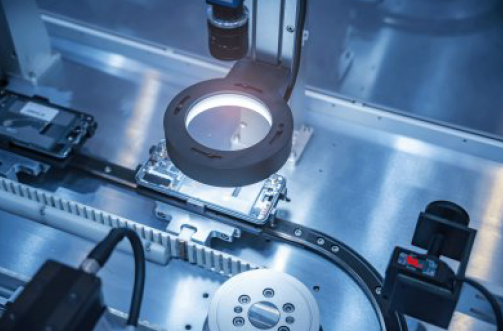
Mitsubishi Electric hopes to revolutionise manufacturing processes
Mitsubishi Electric unveils its new Melsoft Vixio, an AI-powered visual inspection software for quality assurance across industries that can be set up without programming knowledge.
Melsoft Vixio is designed to catch mistakes that the human eye may miss. The system can work vigilantly to ensure every product meets high-quality standards and is not prone to tiring like humans.
There are four phases to how the Melsoft Vixio works. It begins in the learning phase, where the software learns what a ‘good’ product looks like by reviewing previous examples.
Image processing comes next, analysis of product images in conducted in real-time using its algorithms, comparing new images against its existing data set.
Thirdly, decisions are made. Using the analysis, the software gives products either a ‘thumbs up’ if they meet the standards or a ‘thumbs down’ if they do not.
Finally, there is the feedback loop. Over time the software improves itself and engineers can make adjustments to make product recognition more accurate.
Daniel Sperlich, strategic product manager controllers at Mitsubishi Electric, Factory Automation EMEA, said: “Our visual inspection software transforms the inspection process, making it more accurate and efficient. It performs the heavy lifting of primary screenings, identifying potential defects with unmatched precision. Doing so liberates human inspectors to focus on what truly matters—ensuring that only the finest products reach the hands of consumers.”
Melsoft Vixio has also been designed for ease of use and does not require users to have knowledge of programming languages to set it up and use it. The interface allows for setup in three processes. The first, making a picture database, the second is creating the AI model by configuration, and then generating the task via low-code.
Low code is required by engineers to use the product. It will debut across Europe, the Middle East, and Africa and targets industries ranging from automotive to food and beverage.