
Primary aluminium is produced from alumina (aluminium oxide), which in its turn is produced from the sedimentary rock bauxite. The production process often gives rise to high levels of very aggressive hydrogen fluoride (HF), as well as sulfur dioxide (SO2) and nitrogen dioxide (NO2)
Most of these pollutants are caught as an integral part of the production process but some of them may slip through as emissions to ambient air. The industry is therefore often subject to strict environmental regulations, including active monitoring of the emissions. Such monitoring can in some implementations also be used as tools for production control.
ALUMINIUM PRODUCTION
Pure, metallic aluminium is produced through electrolysis of alumina in a pool of fluoride compounds, primarily cryolite. The electrolysis occurs in pots kept at just under 1,000 degrees Celsius. A single industry can house hundreds of pots located in distinct, very large, elongated pot rooms.
Typically, each pot in operation always has several tonnes of alumina and several tonnes of cryolite inside. Differences in density and forces from the electrical field send the molten aluminium metal to the bottom of the pot. It is extracted from there at the same time as new alumina is added from the top.
In addition to the alumina, the carbon anode which leads the current into the electrolyte is a major consumable. The manufacturing of one ton of aluminium requires about two tons of alumina and half a ton of carbon anode, and on top of that close to 15 MWh electrical energy. This makes production of primary aluminium extremely energy consuming, explaining why most production facilities are located where energy is readily available and cheap.
WASTE GAS TREATMENT
The cryolite (Na3AlF6) which is present in the electrolyte is not any major consumable but kept at constant level in a semi-closed loop. Gaseous fluoride compounds originating from the cryolite evaporates from the pots, but the pots are enclosed under normal operations, and the emissions are caught and conveyed to a gas treatment centre (GTC) where alumina is added for adsorption of the fluoride compounds and subsequent feedback to the pots. The alumina mixture added to the pot also contains some sodium and the pot itself therefore produces the cryolite which to some extent is consumed. The GTC typically also captures the sulfur dioxide present in the flue gas through a scrubber process.
POT ROOM MONITORING
The pot rooms are often equipped with gas concentration measurement systems for HF but sometimes also covering SO2, NO2, and possibly other compounds. The systems are crucial for compliance with environmental regulations including the monitoring of emissions to the ambient air.

Pot room gas monitoring may be implemented as point measurements where pumps force air through a filter. The filters are exchanged regularly, and the used filters are sent to a laboratory for analysis. Such approaches may meet the environmental monitoring requirements, but they provide very poor time resolution and there is a substantial delay between sampling and seeing the analysis result. Monitoring data will probably be of limited use from a production perspective. Also, the filter handling is labour intensive.
OPEN PATH, REAL-TIME MONITORING
However, there are also monitoring systems providing real-time data. They can provide excellent information from ongoing production. The effects of a change in production process settings can be seen immediately. This can give valuable insight into both production efficiency and environmental effects. The data can also be linked to alarm systems, for example alerting the operators in case the waste gas feed to the GTC is disturbed.
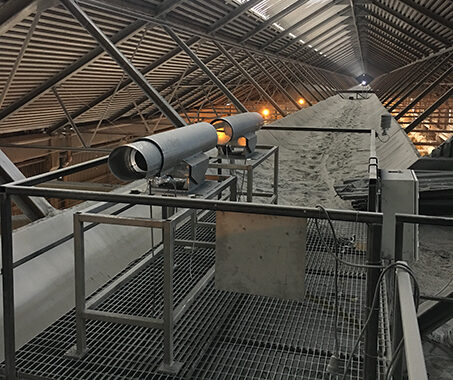
Opsis offers such real-time monitoring systems. There are several variants available, but they are all based on optical detection with a central analyser and with light emitters and receivers. The gas sensing takes place in open light paths, typically aimed along the pot room stretching for several hundreds of metres. In addition to providing real-time data, the light path also means that all pots can be monitored at once. A change in the performance at any of the pots can be seen immediately. This contrasts with point sampling, whether filter-based or real-time, where the instruments only monitor the situation at the pots closest to the sampling point.
FILTER SAMPLING AS A SUPPLEMENT
Filter-based point sampling can be in operation in parallel with real-time, open-path monitors. Although they have poor time resolution, filters still allow detection of parameters such as dust composition, a parameter not readily available using optical techniques. However, detection of gas concentrations in real time have quickly formed the base for both environmental compliance and production process monitoring at those aluminium producers that have acquired optical, open-path gas monitoring systems.
For more information visit: www.opsis.se