Delivering data to drivers without impacting safety
How can OEMs deliver crucial data and information to drivers without impacting attention and safety?
Driving distractions are a growing concern in modern transportation. In the UK alone, distracted driving caused 458 fatalities in 2022 – a 51% increase compared to deaths caused by speeding. Meanwhile, in the US distracted driving accounts for over 3,000 deaths annually.
As vehicle connectivity increases, these distractions multiply; from in-cabin communication and navigation prompts to advanced driver assistance systems (ADAS), all are vying for the driver’s attention. Each demands cognitive capacity and pulls attention from the road ahead. So, how can automotive OEMs still give drivers and passengers all the information they’ve become accustomed to without impacting driver attention and safety?
RIGHT TIME, RIGHT PLACE
There is a huge amount of data in the vehicle cabin that can be valuable for the driver. But drivers need the right driving information to be communicated to them at the right time, in the right place and in the right way – especially in unfamiliar scenarios.
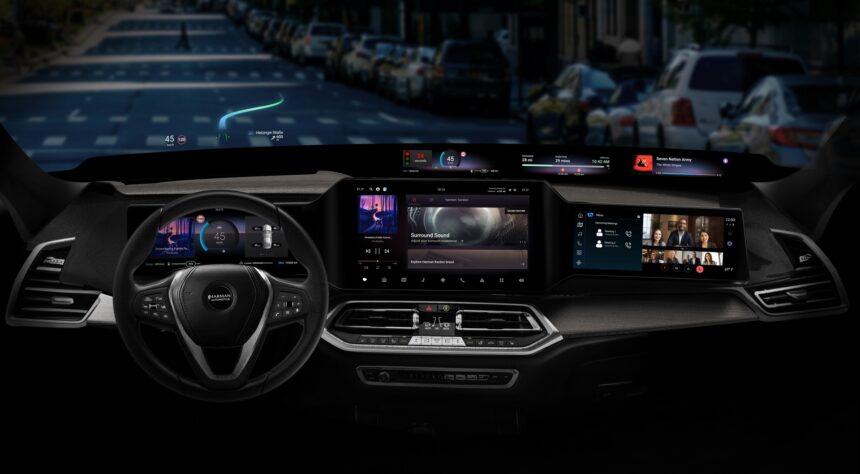
Pursuing the best route to deliver such information, the engineering team at Harman Automotive sought to develop a solution that aligns critical information with the driver’s natural line of sight. Rather than dashboard or cluster displays that require a driver’s eyes to glance downwards and leave the road ahead, the frit area – the black ceramic paint at the base of the windshield – was defined as an effective location for such information.
Utilising this space, the team developed Harman Ready Vision QVUE, which transforms this otherwise redundant area into a functional windscreen display and cluster replacement. Sitting in the dash, a 12-inch Samsung Neo QLED display projects essential driving information onto the frit, with its 5,000 nits, high colour gamut and 254,000:1 contrast ratio ensuring readability in all lighting conditions.
The solution uses in-plane projection, so the critical data appears to be straight in front of the driver rather than out ahead on the street, keeping essential information in the driver’s line of sight. By reducing the need to glance at central infotainment systems or external devices, Ready Vision QVUE helps drivers stay focused on the road. For instance, checking a route alert on QVUE takes just 0.5 to 1 second compared to 1.2 seconds for central infotainment systems, or up to five seconds for third-party devices – time that is critical for maintaining road safety for users.
DESIGN MODULARITY
Needing to cater to a wide range of vehicle models, QVUE has a modular design that allows OEMs to scale the system according to their needs – whether that be a single cluster replacement or pillar-to-pillar coverage that integrates up to four displays to create an ultra-wide field of view. This flexibility extends to passengers too, who can access entertainment, navigation or status updates from their own viewing areas.
QVUE transforms the windshield into dynamic canvases for intelligent and immersive mobility experiences. Bolstering its value, it doesn’t operate in isolation, either. It can integrate with other Harman products, such as Ready Care, which monitors a driver’s vital signs to determine cognitive load. If stress, distraction or fatigue is detected via Ready Care, QVUE can adjust the human-machine interface (HMI) and user experience (US), paring back non-essential information to keep focus on the task of driving.
When combined with technologies such as Ready Care, QVUE can really come into its own. It becomes more than a display – it transforms into a contextual, intelligent system that can move people to emotional responses through its support and easing of stress-inducing factors using its intelligent plug-and-play software. It’s part of Harman’s vision for a suite of products aimed at orchestrating in-cabin information for truly meaningful user experiences.
What’s more, QVUE incorporated advanced directional audio alerts. These notifications – backed by Harman’s legacy in audio excellence – improve situational awareness by enhancing reaction times to hazards such as emergency vehicles. This system increases detection accuracy from 70% to 95%, while reducing driver stress and response times by up to 30%.
As vehicles evolve into smarter, more connected spaces, solutions such as these are paving the way for safer, more intuitive driving experiences. By reducing distractions and personalising information delivery, next-generation, intuitive display technology is setting a new standard for in-cabin experiences – offering a consumer experience within an automotive grade solution.