How advanced ultrasonic testing technology is enabling enhanced corrosion mapping in harsh and inaccessible environments
Inspecting oil and gas infrastructure for corrosion is rarely straightforward. Whether they are strapped to scaffolding on an offshore platform, manoeuvring equipment through tight spaces, or trying to get a clean signal with insufficient couplant – inspectors work at the edge of what’s practical.
Recent developments in phased array ultrasonic testing (PAUT) are reshaping what’s possible. Novel technology developments are helping inspectors collect better data, more efficiently, in places and under conditions that were once impossible hurdles to overcome.
CHALLENGES IN YIELDING RELIABLE DATA
Consistent coupling between the probe and the test surface is essential for quality ultrasonic data. In controlled environments, this is relatively straightforward. But in the field – especially in places such as the remote Alaskan oil fields or in a harness while inspecting at heights – access to a reliable and constant water source is a logistical challenge.
Standard local immersion techniques require a water-supply system to fill the water column between the probe and the surface. This typically requires a steady flow of water pumped from a reservoir. Managing and refilling such a reservoir in remote or at heights applications can be a logistical challenge, and in areas subject to environmental regulations, there could be limitations on the use of free-flowing liquids.
DLA TECHNOLOGY AND EFFICIENT COUPLING
To address these challenges, Dual Linear Array (DLA) probes combined with a XY semi-automated scanner are proving particularly effective. The design of these probes includes spring-loaded rigid delay lines that only require a thin film of couplant. For relatively smooth surfaces where water flow is restricted, these DLA probes can be operated with only a spray bottle – yet still deliver high-quality signals. This feature is particularly useful in rope-access inspections or remote locations, where carrying extra equipment or managing a water source would be cumbersome.
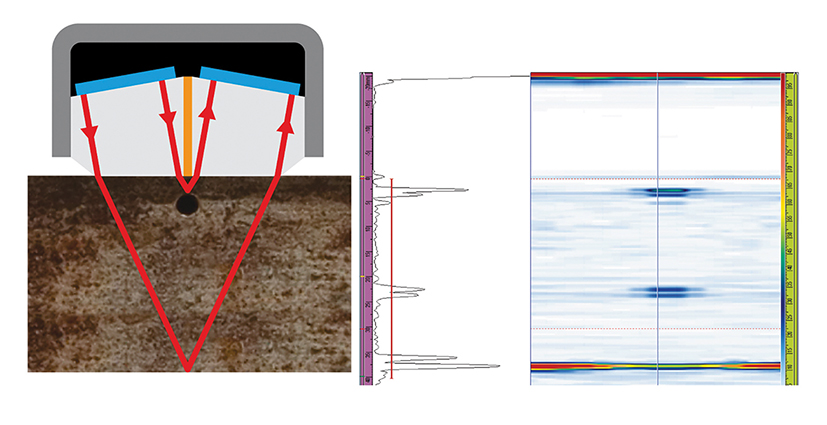
Furthermore, unlike traditional linear probes, the DLA design uses separate, angled transmitting and receiving elements in a “pitch-catch” arrangement. This configuration minimises the interface echo and improves the near-surface resolution, making them ideal for detecting different damage mechanisms such as corrosion, pitting, and hydrogen-induced cracking, even close to the surface.
ADVANCED IMAGING TECHNIQUES
Another advantage of the rigid delay line design of dual phased array systems is that they support the use of the total focusing method (TFM) and phase coherence imaging (PCI). These advanced techniques unlock even greater detail in corrosion mapping and the detection of complex defects. TFM provides high-resolution imaging by processing full matrix capture (FMC) data, enabling crisp focusing throughout the entire region of interest—which is crucial for identifying small or vertically oriented flaws.
PCI adds another dimension of interpretability. Unlike amplitude-based imaging, PCI uses phase-based data to improve characterisation of complex defects, even in areas affected by signal attenuation. For example, tip diffraction signals from stress corrosion cracking are more easily visualised with PCI. The result is a deeper understanding of damage mechanisms and their severity, enabling inspectors to make more confident decisions affecting asset maintenance and repair planning.
THE VALUE OF ADAPTABILITY
No two inspection jobs are alike. One day might involve a quick manual scan of a small section of pipe, the next, a full-scale corrosion mapping survey on a remote stretch of pipeline. Field teams need equipment that adapts on the fly – without sacrificing data quality or forcing a complete setup overhaul.
That’s where modular, versatile inspection systems play an important role. Whether installed in a simple carriage for handheld use, paired with an XY-encoded scanner for corrosion mapping, or deployed on motorised crawlers for automated coverage, the same core imaging tools can scale to match the job. Beyond convenience, this flexibility also unlocks greater efficiency and consistency, enabling inspectors to adapt to real-world constraints without compromising results. For operators managing multiple assets or tackling inspections under time and access pressure, the ability to switch configurations seamlessly is a substantial advantage.
VERSATILE SOLUTIONS
Corrosion inspection requires equipment that is easily transportable and that adapts to different parts and inspection conditions. The good news is that there are ultrasonic scanning solutions that check these boxes. Whether you need to perform immersion-quality 2D corrosion mapping on rough surfaces or you need to inspect a smooth surface with minimal couplant, today’s advanced phased array systems solve these challenges.
Simon Alain is director of global product management, scanners & solutions at Evident.