A satellite-backed AI solution promises to help mining operators navigate extreme weather.
Climate change means much of the world is suffering from more erratic weather than it once did. This might include increased rainfall, higher winds than expected or extreme drought. Such unpredictable weather is causing safety and other problems for a variety of industries. In fact, the World Economic Forum’s 2024 Global Risks Report paints a harrowing picture, with these changes meaning potential financial losses to the global economy of $350bn with profound implications for safety and continuity. This landscape demands not just awareness but action.
The mining industry’s vulnerability
The mining industry is particularly exposed to such weather. For example, extreme rainfall can cause polluted rainwater to run from a mine into a nearby village if precautions are not taken; high winds can blow debris onto nearby farmland; and drought or very hot temperatures might impact machinery for example.
That mines are often situated in parts of the world with a less developed infrastructure than might exist in the US or Europe, for example, makes mining operators and communities around mines particularly vulnerable to the impact of extreme weather.
It is clear then how mining operators will benefit from accurate weather-related information to help with operational planning.
Tomorrow.oi’s technology explained
In 2016 a Boston-based group of technology entrepreneurs recognised that the business need for weather information was acute and becoming more so and therefore launched Tomorrow.io – a proprietary software and AI weather company to help businesses manage these issues. The company has since been featured in TIME magazine as one of its 100 most influential companies.
Chief marketing officer for the company, Dan Slagan, explained how the company came about: “We realised that changes in weather were significantly impacting business but that most weather companies were repackaging publically available information, and that meteorologists were acting as account managers for these companies. The business element was missing. We therefore decided to automate weather information for businesses and build software as an API that included all a company’s operating protocols. We then calculated this against their risk threshold. This has basically delivered a system that manages weather 24/7.”
Tomorrow.oi’s automated system therefore provides a mining company with a level of foresight that allows for the adjustment of work schedules, maintenance, and transportation plans, ensuring that operations run smoothly, regardless of the weather.
More specifically it will provide a company with information detailing when it can and can’t blast for example using the information provided.
Slagan explained: “Blasting at the right time is absolutely critical for mine operators. One of our customers had previously been shut down for blasting during high winds and subsequently polluting a neighbouring village, there was considerable legal fallout from this. You can see then how useful our solution is.”
Slagan added: “The software might also take into account high winds for example, or when an essential road might be closed because of heavy rains, this is extremely important information for mine operators looking to minimise downtime.”
The company is currently working with a handful of big-name mining companies to provide weather insights that will improve decision making, staff scheduling optimisation and supply-chain resilience.
Resilience platform
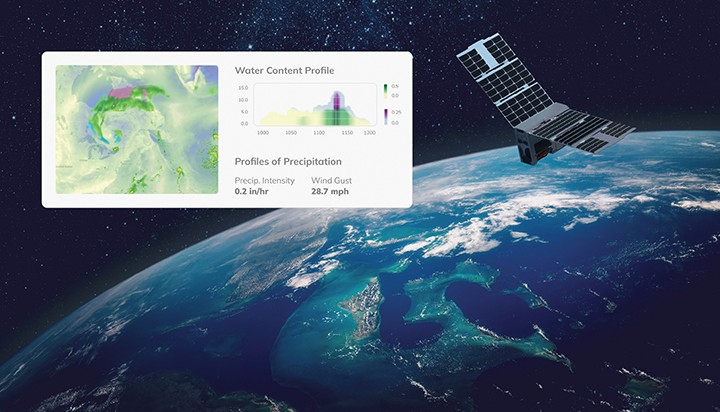
This original proprietary modelling combined with AI was enhanced in 2023 when Tomorrow.oi launched the first of a series of satellites. A further seven have been launched since, and the constellation, called Platform Resilience, will ultimately be made up of a hybrid mix of more than 30 satellites, all operated by the company. The importance of these is that the data is more accurate than that delivered by other satellites and that this weather information is owned by Tomorrow.oi.
How do the satellites work?
The satellites have active (radar) and passive (microwave sounders) sensors which deliver very accurate and detailed pictures of weather formations. The platform constellation satellites both carry a Ka-band Software Defined Radar which uses backscatter to profile precipitation in the atmosphere, and scatterometry to measure relevant parameters of the ocean surface.
Performance specifications
The Ka-band radar sends and receives radio waves with a frequency of 35.75GHz. This radar is observing over a 400km field of view with a horizontal spatial resolution of 5km and a vertical resolution of 250m. The company’s satellites span the entire globe.
Conclusion
In the mining industry, every minute of operation counts, and weather-induced downtime can lead to significant losses. Tomorrow.oi’s advanced weather forecasting combined with predictive analytics offers a powerful way of mitigating problems associated with climate change to maximise operating time and efficiency for mine operators regardless of where they are situated in the world.
For more information visit: www.tomorrow.oi