
Polymeric technology implemented into wind turbine blade protection to help achieve sustainability
Signs of severe erosion on the leading edges of 42 wind turbine blades at a wind farm in Denmark led to the use of polymeric leading edge protection technology, having previously used more expensive technologies to remedy the problem.
Pre-formed shells that were bonded onto the substrate to provide leading edge protection proved to be time-consuming and costly, pushing the wind farm to consider alternative options.
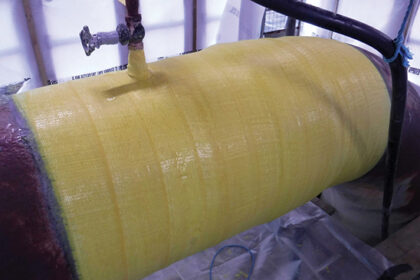
Polymeric repair composites and high-performance protective coatings are used to repair and protect key infrastructure in the wind industry including turbine blades, nacelles and generating components, turbine bases, towers, transformers, and other assets.
A combination of Belzona 5711 and Belzona 5721 was chosen to repair and protect leading edges due to its ease of application and high-quality finish according to test results.
Thixotropic paste is designed for application with Belzona 5711 and Belzona 5721 to create a protective coating. Leading edge erosion and impact damage on wind turbine blades can be repaired in situ using this solvent-free LEP system.
Morten Sivertsen, general manager at AESSEAL Danmark said: “Surface preparation was carried out on each of the 42 blades, followed by the direct application of 90kg of Belzona 5711 from self-mixing cartridges onto the blade. The repair area was then contoured using a piece of Belzona mixing board.
“Once cured, a visual inspection was conducted to ensure the application’s readiness for overcoating with 144 kg (317.5 lbs) of Belzona 5721. Using a short-bristled brush, this system was then applied to the leading edge and left to cure for 30 to 60 minutes. With three rope access technicians carrying out the applications, on average, six to nine turbine blades were completed each day.”
Minimal downtime is suffered operating in-situ repairs as the polymeric systems applied do not need specialist tools or equipment. This allows for faster application, reducing downtime and leading to financial savings due to the reduced loss from downtime.
Safeguarding key assets in wind power for the long term is essential to reaching net zero targets by 2050. Using polymeric technology allows owners to avoid the costs and environmental impacts of asset replacement, instead keeping their assets functional and operational. Polymeric technology has a role to play in supporting energy transition to net zero.
Wind and solar electricity generation needs to reach 57% to 78% by 2030 and 79% to 96% by 2050 according to a 2023 report from Climate Action Tracker. In 2022, wind and solar made up 12% of electricity. A major scale-up is required to achieve net zero by 2050.
Windfarms must be maintained to an excellent standard considering the importance of wind energy in the transition to net zero energy says Chloe Hirst. By keeping wind farms maintained sufficiently it prevents the decommissioning and replacement of wind farms. This is not only costly but has a large carbon footprint.
Investing in solutions to make wind turbines' lifespans longer is both more environmentally friendly and economically more viable. This is based on a circular business model, to repair rather than replace.