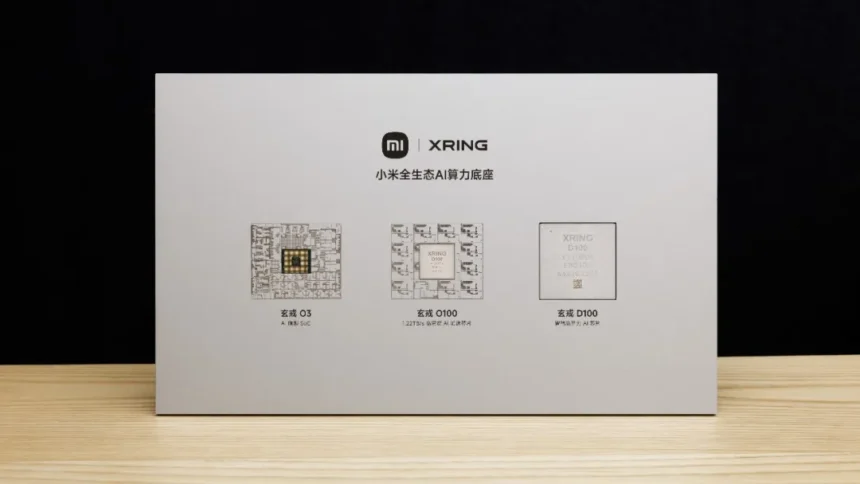
Xiaomi has unveiled three new chips in its Xuanjie family, expanding its in-house semiconductor portfolio with processors targeting edge artificial intelligence (AI), high-bandwidth AI acceleration and intelligent driving.
The company introduced the Xuanjie O3 AI flagship SoC, Xuanjie O100 high-bandwidth AI accelerator and Xuanjie D100 intelligent-driving AI chip. Xiaomi says the devices are intended to provide an AI computing foundation across its ecosystem, spanning consumer devices, vehicles and smart-home applications.
The O3 is manufactured using a 3nm process and measures 133mm², incorporating 24 billion transistors. Xiaomi says its Top Channelless technology increases transistor density by 5%, while the number of independently designed standard cells has increased from 480 in the previous-generation O1 to more than 2,400.
The processor uses a 10-core CPU comprising six super-large and four large cores, with a maximum clock speed of 4.35GHz. Xiaomi reports Geekbench 6.5 scores of 3,945 for single-core and more than 15,000 for multi-core performance.
The O3 also introduces LPDDR6 support, with Xiaomi claiming a memory bandwidth of 113.8GB/s and memory access latency of 82ns. Its cache configuration comprises 12MB of L2, 16MB of L3 and 16MB of system-level cache.
AI processing is a particular focus. The O3’s NPU provides up to 200 TOPS of tensor computing performance, alongside a 3.13 TFLOPS vector computing unit. Xiaomi says its combination of a five-value quantisation model and hardware Huffman compression can reduce memory bandwidth requirements by 30%.
The Xuanjie O100 takes a different approach, targeting the memory bandwidth limitations of AI workloads. It uses 6nm 3D wafer-level stacking, combining two layers of high-speed DRAM with an NPU layer. Its hybrid-bonding architecture has a 1.4μm bond pitch, while a face-to-face metal connection is designed to shorten interconnect distances.
Xiaomi reports bandwidth of 1.22TB/s from the O100, supported by 14 NPUs and a high-bandwidth matrix bus with dynamic topology switching.
The third device, the 3nm Xuanjie D100, is aimed at intelligent driving. It combines a 20-core CPU with a 16-core NPU and supports up to 160GB of unified memory and AI models containing up to 200 billion parameters.
Xiaomi says all three chips have completed verification. The O3 will debut in the Xiaomi 18 Fold, while the O100 and D100 are scheduled for commercialisation next year. The company says its chip development programme has involved more than 21 billion yuan of cumulative R&D investment and a team of nearly 3,000 specialists.