Yamaha Robotics has engineered adaptations for placing large components at speed
Telecom, internet, and automotive sectors are driving demand for larger, heavier, and more complex components, posing new challenges for electronics manufacturers
In telecom infrastructure and data centres, switches and server cards are adopting custom processors to meet the need for compute-hungry services and AI acceleration. The largest adaptive FPGA compute engines are now housed in BGA packages up to 55mm x 55mm, while multi-chip ASIC processors can be even larger, particularly with fan-out interconnects.
Automotive electronics are scaling too. Embedded systems require increased current delivery, expanded I/O for sensors such as radar and lidar, and larger connectors for higher data and power demands. Large bottom-terminated packages, such as BGAs, which were once avoided due to inspection challenges, are now being adopted out of necessity.
Manufacturing challenge
Equipment manufacturers must accurately place large and heavy components at high speed and yield. This requires secure pick-up, precise alignment, and reliable placement, as well as solutions for through-hole parts such as connectors and transformers. Traditionally, such challenges have exceeded the capabilities of standard surface-mount equipment.
Inline solutions that utilise standard machines are preferable, as they avoid the need for specialist equipment or offline assembly.
Flexible placement solutions
Yamaha Robotics has engineered adaptations for placing large components at speed. Key developments include:
- Gripper nozzles that combine suction with claws, now offered in standardised configurations to replace costly custom designs. Yamaha has standardised claws and backing plates to create 60 possible combinations for different component types and sizes
- Rubber pad nozzles that lift heavy ICs using suction, available in diameters up to 25mm. Part-specific nozzles for components such as DIMM memory sockets are also in development
- Advanced R and Z axes control, including backlash-free scissor gearing for precision rotation to 0.005 degrees, and extended Z-axis stroke of 40mm for tall components
- Placement force upgrades, raising control from 30N to 100N for press-fit connectors. Landing detection and laser vision systems ensure pin alignment before insertion
New LM placement head
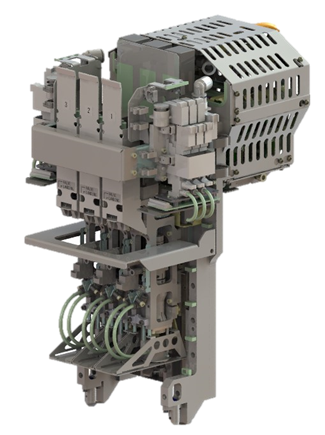
Yamaha’s new LM placement head integrates these features, handling larger ICs, taller components, and press-fit parts alongside standard SMDs. It supports existing nozzles and introduces automated nozzle health checks for maintenance.
The LM head also expands recognition capabilities, increasing maximum IC package size from 55mm to 130mm and maximum BGA ball count from 4,000 to 20,000 – enabling accurate placement of today’s largest FPGA and ASIC packages.
By extending the flexibility of surface mounters, Yamaha enables factories to handle everything from small passives to multi-chip ASICs and high pin-count connectors with speed and efficiency. The company says the LM head presents a cost-effective way for manufacturers to adapt quickly to evolving demands in telecom, data centre, and automotive markets.