As electric vehicle adoption continues to accelerate, attention is increasingly shifting from battery capacity alone towards the wider energy ecosystem that surrounds the vehicle
Charging infrastructure, electricity costs, renewable energy integration and grid stability are all becoming critical considerations for manufacturers developing the next generation of electric transport.
Against this backdrop, Nissan is leading a major UK research programme that aims to rethink how electric vehicles generate, manage and exchange energy. Known as Project SUITE (Smart Use of Integrated Technology for EVs), the three-year initiative brings together automotive manufacturers, technology specialists and leading universities to develop an integrated suite of energy management technologies that could significantly reduce operating costs while improving vehicle efficiency and supporting the electricity grid.
A COMPREHENSIVE COLLABORATION
Supported by £10 million of UK Government funding through the £4 billion DRIVE35 programme, delivered by the Department for Business and Trade in partnership with the Advanced Propulsion Centre UK (APC) and Innovate UK, the project represents one of the UK’s most comprehensive collaborative research programmes focused on the convergence of vehicle electrification and intelligent energy management.
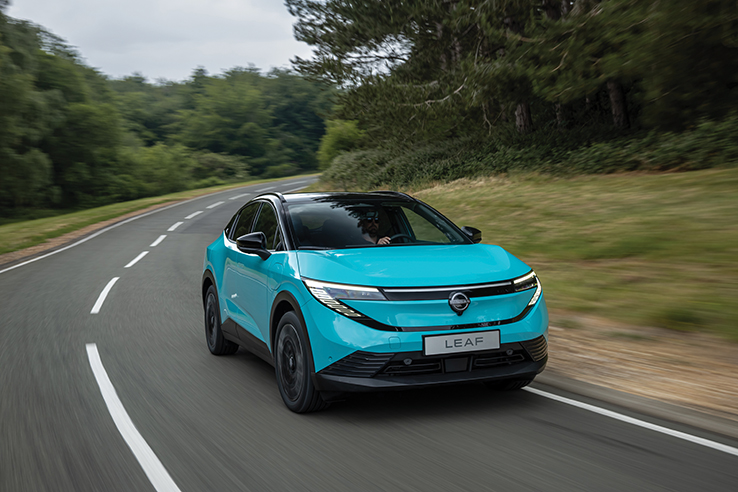
Rather than concentrating on a single technological breakthrough, Project SUITE seeks to combine multiple complementary systems into a single production-ready architecture. Engineers at Nissan Technical Centre Europe in Cranfield will lead development, using the latest British-built Nissan LEAF as a demonstration platform to validate the technologies under real-world operating conditions.
For vehicle manufacturers, one of the most significant aspects of the programme is its systems-level approach. Instead of treating charging, renewable generation, power electronics and vehicle controls as separate disciplines, Project SUITE integrates them into a unified energy ecosystem designed to optimise efficiency throughout the vehicle’s operating life.
“This project highlights the strength of UK innovation and marks a significant step towards the next generation of integrated energy technologies for electric vehicles,” says David Moss, senior vice president, research and development, Nissan Africa, Middle East, India, Europe and Oceania (AMIEO). “Through close collaboration with industry and academic partners, we are advancing solutions that lower the cost of ownership, improve efficiency and deliver greater value for customers.”
SOLAR POTENTIAL
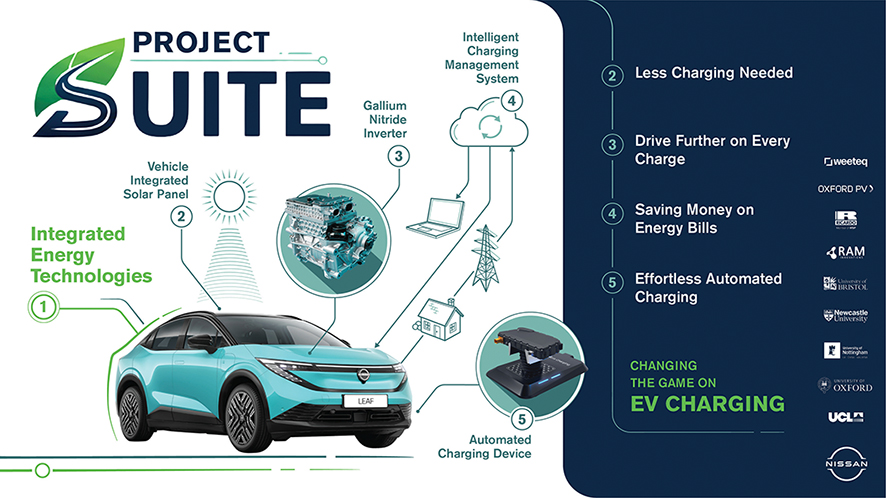
One of the most visible technologies under development is vehicle-integrated tandem solar panels. Unlike conventional rooftop photovoltaic systems that primarily support auxiliary electrical loads, these automotive solar modules are intended to contribute directly to battery charging. By harvesting renewable energy whenever the vehicle is parked outdoors, the system has the potential to extend driving range, reduce reliance on grid electricity and lower charging frequency, particularly for vehicles operating predictable daily duty cycles.
INTELLIGENT CHARGING
Complementing the onboard solar technology is an Intelligent Charging Management System (ICMS), designed to optimise electricity consumption based on energy demand, electricity tariffs and renewable generation. Beyond simply scheduling charging for off-peak periods, the system is intended to manage household energy consumption while allowing stored vehicle energy to be exported back to the electricity network when appropriate.
VEHICLE-TO-GRID
Vehicle-to-Grid (V2G) capability forms another key element of the programme. Although V2G technology has been demonstrated for several years, widespread deployment has been constrained by infrastructure complexity and user interaction. Project SUITE addresses these challenges through the development of a bidirectional Automated Charging Device (ACD) capable of maintaining seamless grid connectivity while simplifying the charging process for vehicle owners. The objective is to make bidirectional charging more practical for everyday operation while improving access to distributed energy storage across the electricity network.
POWER ELECTRONICS
Power electronics also play a central role in the programme. Ricardo is developing a high-efficiency Gallium Nitride (GaN) traction inverter incorporating AI-enhanced control strategies. Gallium Nitride semiconductors offer significantly higher switching frequencies and lower electrical losses than traditional silicon devices, enabling smaller, lighter and more efficient inverter designs. When combined with intelligent software capable of optimising operating parameters in real time, the technology has the potential to improve drivetrain efficiency while reducing overall system costs.
Artificial intelligence extends beyond inverter control. Several academic partners are contributing digital modelling and forecasting technologies to improve V2G energy management, optimise electricity network interaction and better predict vehicle charging requirements. Together, these capabilities aim to create a highly adaptive energy management system capable of responding dynamically to both driver behaviour and grid conditions.
Moss adds, “From enhanced V2G capability to high-performance inverters and solar assisted charging, these developments reinforce the UK’s role in building a smarter, more resilient energy ecosystem. Together, we are laying the groundwork for future electrified products and reaffirming our commitment to making electric mobility more accessible, convenient and sustainable for all.”
STRENGTHENING UK INFRASTRUCTURE
The programme also reflects wider industrial policy aimed at strengthening the UK’s automotive technology base. By bringing together vehicle manufacturers, SMEs and academic institutions, Project SUITE is intended not only to develop new technologies but also to establish domestic capability across advanced power electronics, intelligent charging systems and renewable energy integration.
“Collaborative projects demonstrate the UK’s determination to lead the shift to zero-emission mobility,” adds Ian Constance, CEO of APC UK. “By facilitating the UK Government’s DRIVE35 grants, we are turning world-class innovation into industrial capability. With our partners in DBT and Innovate UK, we are backing manufacturers, empowering SMEs, and strengthening the UK’s sovereign supply chain.
“This multi-million pound support package is more than an investment in technology; it is an investment in the people, skills and companies that will define the future of clean transport. Together, we are building the foundations of a competitive, resilient and sustainable automotive industry.”
With Project SUITE, Nissan and its partners are seeking to establish a blueprint for the next generation of intelligent electric vehicles.