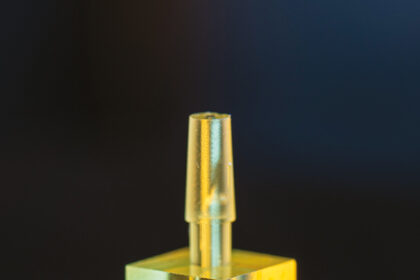

Decorative chrome plating has been a cornerstone of automotive component manufacturing for more than 70 years, providing the durability, corrosion resistance and premium finish expected for interior and exterior trim
However, increasing environmental regulation and changing OEM sustainability targets are driving a gradual transition away from traditional hexavalent chromium processes towards trivalent chromium and fully chrome six-free plating technologies.
Pablo Javier Ramos Cuevas, global sales engineer at Taiyo Manufacturing, outlines how manufacturers are preparing for the industry’s next major process change. “The European Union restricted the use of Chrome 6 in 2017 and its sunset data is still pending, but by the end of this decade the usage of Chrome 6 for decorative plating processes should be stopped altogether in the EU,” he says.
Hexavalent chromium has long been favoured because of its process stability, production consistency and suitability for high-volume manufacturing. It remains widely used not only within automotive plating but also across industries including stainless steel production and textiles. However, its environmental and health implications have led regulators to seek alternatives.
Cuevas explains, “It is stable and suitable for mass production, but it’s also harmful for the environment and the human body.”
A MORE SUSTAINABLE OPTION
One of the principal alternatives is trivalent chromium. Unlike hexavalent chromium, trivalent chromium occurs naturally and is already produced during conventional wastewater treatment, where hexavalent chromium is chemically converted into its safer trivalent form before disposal.
“Because Trivalent Chrome is not 100% Chrome, but an alloy itself, we can play with the composition of this alloy to create different chrome colours, and it is much more environmentally friendly than the current alternatives,” says Cuevas.
For automotive manufacturers, the transition is occurring at multiple levels. While many suppliers have already adopted trivalent chromium for the final electroplating stage, the pretreatment process has historically continued to rely on chromic acid containing hexavalent chromium.
ELIMINATING CHROME 6
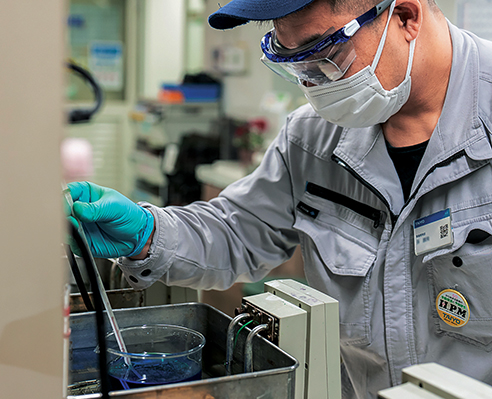
Taiyo Manufacturing’s latest development addresses this remaining challenge through a completely chrome six-free pretreatment process using alternative etching chemistry based on permanganic acid.
Replacing chromic acid during pretreatment offers several operational advantages in addition to regulatory compliance. The alternative process eliminates the need for mist suppressants traditionally associated with chromic acid, allowing manufacturers to establish completely PFAS-free plating operations while simplifying wastewater treatment. The revised process also reduces manufacturing complexity.
Compared with conventional decorative plating, where cleaning, etching, conditioning and multiple rinsing stages are performed sequentially, the chrome-free process combines several operations within the same processing tank.
“This will eventually save costs on water, energy, and also time, making it more efficient,” Cuevas explains. “When mass production goes up, we can expect to achieve the same cost, or, depending on the case, might be even cheaper than the traditional process.”
LOOKING GOOD
Maintaining aesthetic quality has historically represented one of the biggest obstacles to wider adoption of trivalent chromium. Automotive interior components demand highly consistent bright chrome finishes that have traditionally been difficult to replicate using earlier trivalent chemistries.
Taiyo Manufacturing believes this challenge has largely been overcome through a new trivalent chemistry developed with Okuno Chemical Industries. Cuevas says: “We managed to get brighter and more blue finishes compared to the traditional Trivalent Chrome finishes. We can get virtually the same colours as we can get with Chrome six, and this enables the possibility of using this technology for automotive interiors.”
The company’s sustainable plating process entered mass production in 2022, supplying Volvo programmes in Europe, while development continues with additional OEMs evaluating both trivalent chromium and fully chrome six-free production.
Market momentum is also increasing outside Europe. Cuevas explains several North American manufacturers have already established transition strategies following growing regulatory scrutiny surrounding chromium use.
General Motors has confirmed that all interior chrome-plated components from 2027 onwards will use trivalent chromium, while Toyota North America has committed to transitioning first to trivalent chromium before adopting fully chrome six-free plating. Other manufacturers, including Ford and Honda, are also developing trivalent chromium finishes, while European OEMs such as Mercedes-Benz, BMW and Audi continue evaluating production-ready solutions.
Despite this, Cuevas notes, “There are still many companies that are abiding by this to use the same processes without changing anything. There are some loopholes that are slowing the transition towards Chrome 6-free usage.”
Investment requirements, regulatory uncertainty surrounding chromic acid authorisations and the industry’s perception of decorative chrome plating continue to slow adoption.
A WIDER TRANSITION
Nevertheless, Taiyo Manufacturing +believes the long-term benefits extend beyond regulatory compliance. Alongside reducing hazardous chemicals and lowering water and energy consumption, the company has already demonstrated the feasibility of plating advanced PC-ABS substrates while maintaining production quality suitable for automotive applications.
Combined with its use of 100% renewable electricity and continuously monitored wastewater treatment facilities, the company’s approach reflects the wider transformation taking place across automotive surface finishing. As sustainability targets tighten and lifecycle environmental performance receives greater scrutiny, the ability to deliver premium surface finishes through safer, more resource-efficient manufacturing technologies is likely to become a key competitive differentiator across the transport manufacturing landscape.