
As the global energy transition picks up pace, industrial energy efficiency is increasingly gaining importance. With rising demand from AI and data centres accelerating this shift, maximising the use of each unit of electricity is key
“Industry has spent decades optimising what happens inside a plant. Yet large motors and generators have rarely been part of that conversation, even though they run continuously for 25 years and sometimes even more, converting more energy to motion than almost anything else on site,” says David Bjerhag, global business line manager, high speed synchronous, at ABB. “The gap between a standard machine and a TIE-optimised one is not technological. It is a specification gap. The companies closing it fastest are the ones where the engineer who selects the motor and the CFO or CSO responsible for energy performance are aligned around a single metric: total cost of ownership.”
TIE refers to ABB’s Top Industrial Efficiency initiative, which was launched to encourage the adoption of the highest-efficiency large motors and generators available today. Backed by a growing body of operational data and extensive engineering development, the initiative aims to push the boundaries of what is technically achievable. The Industrial Efficiency Gap, a new report from ABB, examines a decade of data for over a thousand large motors and generators delivered globally by ABB’s Västerås facility in Sweden.
International Design Engineer was invited out to the facility to hear how the company is unlocking one of the largest untapped opportunities to save energy, cut costs and reduce emissions across global industrial sectors.
THE SCALE OF OPPORTUNITY
Industrial electrification is being driven by the replacement of combustion-based systems with electric motor-driven solutions and the upgrading of existing electrical systems to higher efficiency technologies. This means that the performance of the entire motor-driven system – drives, controls and operating system – is vital for overall system efficiency. Still, large motors and generators are one of the most significant asset investments heavy industry operators can make.
“Large motors might only be a small fraction of the total amount of motors installed globally, but they still consume around 20-23% of the total electricity of all motors,” explains Bjerhag. In fact, motors rated above 375kW account for an estimated 10.4% of global electricity demand today, and this figure is expected to double by 2040.
According to ABB’s TIE Gap report, a persistent gap remains between achievable and realised efficiency within these systems, particularly across industries such as oil and gas, metals, chemicals, utilities and pulp and paper.
EFFICIENCY MATTERS MORE THAN EVER
The TIE initiative was developed against a backdrop of increasing pressure on industry to reduce energy consumption and emissions. The International Energy Agency (IEA) has estimated that improvements in energy efficiency could deliver more than 37% of the greenhouse gas reductions required to achieve global climate targets. ABB cites this finding as one of the primary motivations behind TIE.
Bjerhag believes efficiency improvements offer a particularly attractive route because they can often be implemented without major infrastructure changes: “Going from an efficient motor to a highly efficient one doesn’t require a drawn-out permitting process, you can simply do it right away,” he says.
Unlike many decarbonisation technologies, motor-based efficiency upgrades typically integrate easily into existing industrial processes while delivering immediate operational benefits.
The TIE Gap report is based on data from over 1,000 large synchronous motors and generators from ABB’s Västerås facility that were delivered worldwide between 2015 and 2025. For large synchronous machines, TIE typically improves efficiency from around 98.5% to 98.7-98.8%. The findings show that the 0.2% gap between routinely-specified systems and ABB’s TIE approach is costing operators between $9.5-$12 billion in unnecessary electricity costs and generating 60-75 million tonnes of avoidable CO2 over a 25-year asset life.

THE TIE INITIATIVE
ABB’s TIE initiative delivers large synchronous motors and generators with the highest possible energy efficiency, without compromising reliability or specification compliance. The initiative enables systems to be optimised for lifecycle performance rather than upfront cost, and is available to OEMs, EPCs and end users.
According to ABB’s report, applying the TIE 0.2% efficiency improvement across the global installed base of industrial motors and generators would save 4-6TWh per year. Over a 25-year motor lifetime, that rises to 100-150TWh of electricity saved, equivalent to powering the whole of the UK for five months. The associated CO2 reductions would be an impressive 60-75 million tonnes, or the same as taking 13-16 million cars off the road permanently.
To take advantage of this, though, industry must look beyond upfront cost and embed long-term energy efficiency into procurement decisions. “About 99% of the cost of a motor is actually during its operation phase,” Bjerhag says. “A huge number of megawatts go into a single motor over time, and with electricity costs that becomes a dominating factor over a 25-year lifetime. Therefore, efficiency plays a major role here.”
A NEW WORLD RECORD
ABB’s most recent achievement demonstrates how far efficiency optimisation can be pushed.
“We were able to reach 99.13% efficiency,” Bjerhag explains. “This is something we are extremely proud of.”
The record-setting 56MW TIE-optimised synchronous motor was delivered to a steel plant in India in 2025. Over its lifetime, the machine is predicted to save $5.9 million in electricity costs and avoid 45,000 tonnes of CO2 with a payback period of just over three months.
According to the TIE Gap report, if every one of the thousand standard machines delivered by the Västerås factory over the past decade had been specified under the TIE option, 11.1TWh of electricity could have already been saved (approaching $1billion), and 5.9 million tonnes of CO2 might have been avoided.

CHASING FRACTIONS OF A PERCENT
Synchronous machines can be used as a motor, generator or rotating synchronous condenser, and operate by rotating in synchronisation with the supply net frequency according to the relation 120 frequency/poles (rpm). The absence of slip eliminates slip-related rotor losses, contributing the high efficiency. Synchronous machines can operate at lagging, unity or leading power factor depending on excitation, meaning it can boost the net by reactive power.
Reaching efficiencies above 99% requires increasingly sophisticated engineering, says Gunnar Porsby, ABB’s R&D manager of high-speed synchronous machines: “There are five main efficiency losses in a machine – Ohmic losses in the stator winding coils caused by current flowing through stator copper conductors, stator iron losses in the magnetic core of the stator due to time-varying magnetic flux, friction losses, excitation losses and additional losses. To further increase efficiency, we need to consider all of these and analyse what we can try to affect.”
To enable this, ABB has built a comprehensive and continually evolving R&D toolbox that allows its engineers to design machines to suit the specific needs of its customers.
“This toolbox of possibilities is a strategy that distinguishes us somewhat from our competitors,” says Porsby. “We have many alternative technologies and capabilities to design efficient machines and optimise them to the standards and local conditions they will be operating within.”
Artificial intelligence is increasingly becoming a part of that toolbox, he adds: “AI and machine learning is already incorporated into our in-house tools when designing the machines, to help us understand where we can make the biggest impacts.”
The efficiency gains of ABB’s machines are not coming from exotic or untested materials, either. Instead, progress stems from the company’s industry knowledge, increasingly precise manufacturing, and the creative application of established, proven technologies. Digital tools and modelling techniques have advanced significantly, enabling ABBs engineers to explore more design possibilities and simulate and optimise fine details with accuracy.
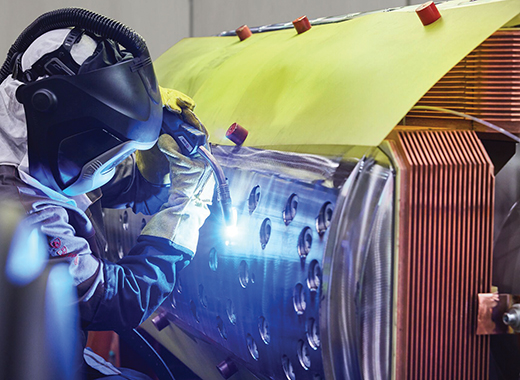
TURNING POTENTIAL INTO IMPACT
ABB’s TIE Gap report sets out a clear set of actions to accelerate adoption of high efficiency machines and also highlights the importance of using total cost of ownership as a primary decision metric. To lower carbon emissions and achieve global climate goals, energy efficiency needs to be embedded into procurement decisions, including specifying minimum performance levels and requesting optimised designs.
ABB’s Västerås operation
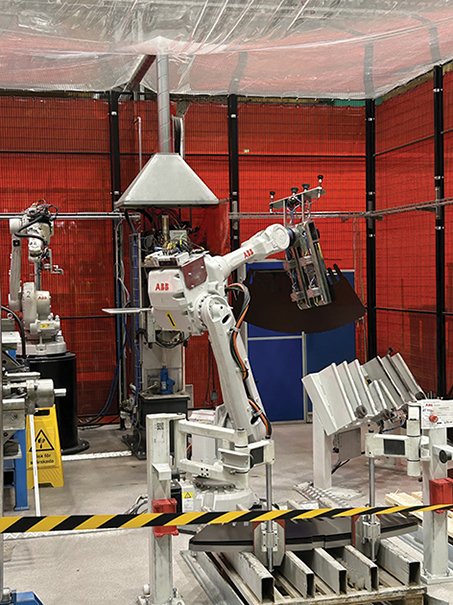
The centre of ABB’s high-speed synchronous motor development is its Västerås facility in central Sweden.
The 22,000m² factory, built in 1976, designs and manufactures ABB’s complete range of high-speed synchronous motors, generators and condensers. Employing around 600 people, it produces up to 200 machines annually and supports an installed base exceeding 4,000 machines worldwide. The site was also the first ABB facility to adopt the TIE concept.
According to ABB, standard large motors produced in Västerås achieve average efficiencies of approximately 98.3%, while TIE-optimised machines have achieved 99.05% efficiency levels, equivalent to an IE7 classification.
TIE sector insights
Air separation/chemicals:
- 85% TIE adoption
- 24/7 operations
- Same owner pays for energy
Oil & gas:
- 10% TIE adoption
- Fragmented value chain
- CAPEX-driven decisions
- Efficiency under-valued
Power generation:
- 15% TIE adoption
- Massive energy volumes
- Continuous operations
- Direct link to fuel & emissions reduction