How the UK’s largest automotive vehicle manufacturer has evolved its approach to composite design and manufacturing
How the UK’s largest automotive vehicle manufacturer has evolved its approach to composite design and manufacturing.
Built upon two iconic British car brands – Land Rover, known for its premium all-wheel-drive vehicles, and Jaguar, for its luxury cars – Jaguar Land Rover (JLR) is recognised across the globe for its automotive manufacturing prowess. In recent years, the manufacturer has positioned itself as a leader in the transition to electric vehicles (EVs), with Jaguar becoming the first ever brand to offer a premium all-electric performance SUV, the Jaguar I-PACE.
One of the contributing factors behind the company’s success in the electric space thus far has been its approach to material and design, which has seen numerous projects lead to the development of stiffer and lighter vehicle structures for improved EV performance.
“Sustainable mobility is key for a net-zero future with battery electric vehicles (BEVs) playing a central role in this transition,” says Frédéric Sicard, technical specialist composite material and process at JLR. “However, vehicle efficiency is driven primarily by mass, and BEVs are traditionally heavier than Internal Combustion Engines (ICE), which represent an engineering challenge. Composites can deliver weight-saving solutions compared to metals, but they usually come with a higher carbon footprint (CO2e). To balance vehicle weight, cost and CO2e targets, it is vital to optimise the use of such materials to improve the efficiency and performance of our vehicles, while preserving vehicle safety.”
AWARD-WINNING R&D
At the beginning of 2018, JLR initiated the Tucana project – a three-year programme with the aim of making the UK a world leader in low-carbon technology. Leading a consortium of academic and industry partners, JLR sought to accelerate research efforts into advanced lightweight composites with the potential to deliver increased range, greater performance and a more dynamic driving experience for future BEVs.
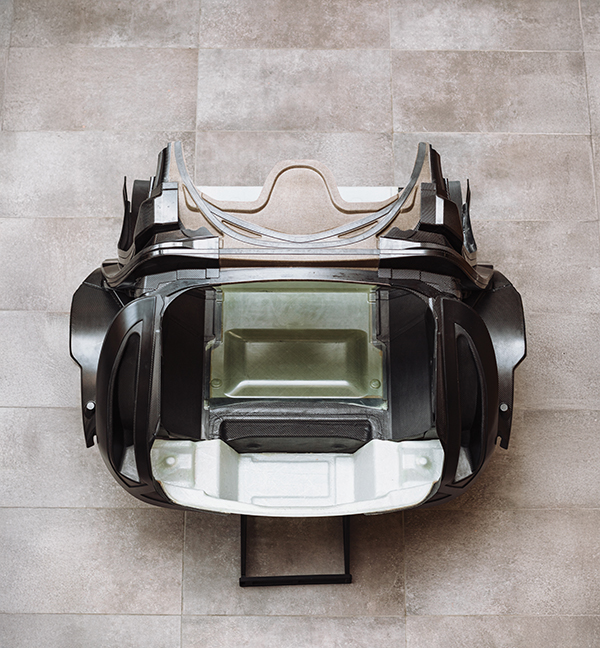
“The Tucana project’s primary objective was to enable stiffer, lighter and more affordable design to BEVs by using composite materials, taking the rear body structure of a Jaguar I-PACE as an example,” says Sicard. “The R&D project came to a close in October 2021, achieving 30% uplift in torsional stiffness, 30% weight saving, a 65% part reduction and an estimated saving of 4.5 million tonnes of CO2e over a 10-year use-phase thanks to the optimised composite design.”
The results of the project were impressive, with the innovative design receiving two awards: The 2021 Composite UK Award for Innovation in Composite Design, and the 2022 JEC World Innovation Award for Automotive and Road Transportation – Structural.
“From a digital design perspective, we used similar techniques and tools used by our engineering colleagues to develop future JLR products while applying these to composite materials characteristics,” Sicard says. “The design was initiated by conducting iterations of topology and topometry optimisation to determine the optimum load paths. While more than 75 load cases were considered before completion, the optimisation focused on the three most relevant cases, including torsional stiffness and rear crash. As the digital work progressed, a testing and manufacturing campaign was deployed to validate materials and assess the processability and compatibility with JLR paint processes.”
In parallel to this, the digital design was refined with Design for Manufacture (DfM) inputs. “Key features and critical geometries were validated through physical experimentation using demonstrator tooling,” Sicard adds. “Specific tests were also performed on manufactured demonstrator components.”
ONE STEP FURTHER
In February 2021 JLR doubled down on its all-electric business with the launch of its Reimagine strategy.
However, the Tucana project in its original concept was not meeting the company’s new sustainability ambitions, Sicard acknowledges: “Through Reimagine, JLR is looking holistically at sustainability and is transforming in an all-electric business,” Sicard explains. “JLR will be preventing the emission of millions of tonnes of CO2e by delivering electric models of all its luxury vehicles by 2030. JLR’s approach to addressing environmental impacts goes beyond tailpipe emissions, aiming to achieve a more resource efficient economy through reducing waste and repeated circulation of products and materials – use less, extend the life of what we have, and reuse wherever possible. With an updated approach to sustainable composites, efforts have been refocused on redefining our materials roadmap, bridging the sustainability and circularity gaps on materials.”
In particular, the company’s composite material roadmap has shifted towards sustainable and circular materials that display high-performance properties.
“The first and short-term milestone is the development of high-performance and low CO2 composite materials,” explains Sicard. “Learnings from Tucana highlighted virgin carbon fibre as the main contributor to the concept CO2 footprint -or global warming potential (GWP) – therefore, we are looking at materials originating from recycled feedstock, natural fibre, or non-oil-based, as credible opportunities.”
With these circular economy principles embedded, JLR is now investigating technologies capable of reducing waste and energy, or enhancing the properties of these innovative sustainable materials whilst being careful of their compatibility with its final products and business case.
“Our latest Sustainably Optimised Composite Automotive (SOCA) project reused the Tucana design to investigate the performance and viability of sustainable material alternatives,” Sicard continues. “Following the same framework, we collaborated with partners to manufacture the optimised load path, parts and completed the assembly of two full-scale demonstrators, exhibited at Cenex Expo and the Advanced Engineering Show in 2024.”
According to Sicard, the SOCA project demonstrated that the Tucana CO2 footprint could be improved by around 60% and compete with the original aluminium structure CO2-wise, while remaining lighter and stiffer.
“Results and learnings from projects like Tucana or SOCA are compatible with JLR sustainability and circularity ambitions, compliant with legal requirements and supporting the transition to a net-zero and BEV future, without compromising on quality,” he adds.
WHAT'S NEXT
As Sicard attests, historically end-of-life management and efficient recovery of composite materials have been challenging.
“In its original scope, Tucana presented difficulties regarding both dismantling and segregation,” he says. “However SOCA, which aimed at decarbonising the manufacturing of composite components for automotive, offered a viable route to market for reducing the environmental impact of carbon fibre components. The adoption of material derived from SOCA would first target JLR current carbon fibre components with the goal of decarbonising their manufacturing. Then, they would match the end-of-life requirements and the current availability of materials in the supply chain. Longer term, as the supply chain scales up, the ambition is to roll this out on future JLR vehicles.”