
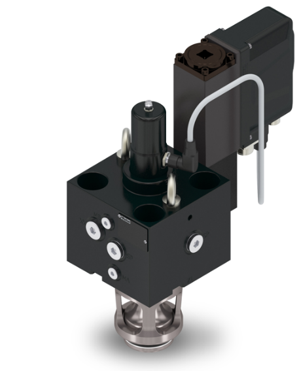
Parkers new proportional cartridge valve claims to be fastest in its class
Motion and control technologies company Parker Hannifin has unveiled the latest version of its proportional cartridge throttle valve series, TFP, joined with its DFplus generation IV pilot valve. The valve will further reduce step response time by 30%, making TFP the fastest in its class.
The sleeve and spool design allows for previously unachievable volume flow and pressure drop values. The TFP series enables shorter cycle times, more stable processes and minimal scrap rates.
The PLC can communicate with the DFplus generation IV pilot valves by using the dual-core processor, allowing it to run at maximum performance. The retention of the analogue command signal combined with the valve's standard IO-Link connection for communication remains unique.
Further shortening of the acceleration phase of the shot cylinder in a die-casting machine is possible through this communication technique. This allows for the production of structured and large-area die-cast parts with high and repeatable quality.
Mobile devices can connect to a near-field communication (NFC) chip to monitor status information in the field or in service situations. This is possible even when the valve is not currently powered. The data is available for viewing on the ‘Parker Device Connect’ app. An LED light at the top of the electronics box ensures basic status data is immediately visible by using different colours or flashing frequencies.
The TFP was originally launched in 2021 and the main stage remains unchanged. The valve is characterised by a pressure-compensated sleeve with an enlarged seat diameter and oriented windows. The valve nearly completely uses the DIN cavity. It has a maximum pressure of 420bar, leading to high flow values of up to 25,000I/min depending on the nominal size.
The modern controller structure allows step processes can be reduced by up to 30% whilst maintaining the precise opening and closing operations. This increases volume flows in a shorter time, increasing performance in demanding applications.
Application usage is extended by the properties of the new valves, which are suitable as a 1:1 replacement for TFP valves with DFplus generation III valves.