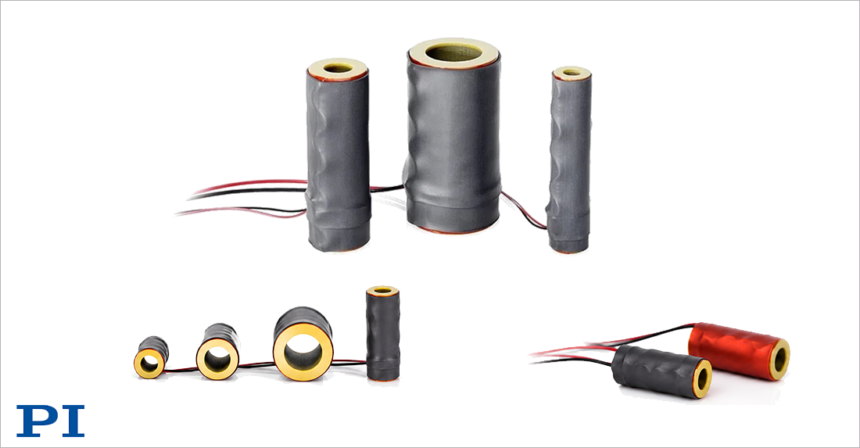
Physik Instrumente (PI) has introduced a range of ring-type PZT actuators designed to provide fast, nanometre-scale positioning while maintaining an unobstructed central aperture. The PICA-Through actuators combine characteristics of linear piezo stack and tube actuators, targeting applications in optics, photonics, microscopy, metrology and precision manufacturing.
Available in 12 standard variants, the actuators use outer diameters of 10, 16 and 25mm, with corresponding inner diameters of 5, 8 and 16mm. According to PI, the devices provide travel of up to 80µm, blocking forces as high as 9,600N and stiffness of up to 580N/µm. Vacuum-compatible versions are also available.
The through-hole architecture allows optical fibres, probes, wiring, vacuum lines, fluidic channels and optical beams to pass through the actuator. This enables coaxial designs in which motion is generated around the optical or mechanical axis, potentially reducing system dimensions while improving mechanical stiffness and simplifying routing.
The company states that the actuators can be used for fibre alignment, optical cavity tuning, objective and lens positioning, laser beam delivery, adaptive optics, microfluidic control, precision dispensing and valve actuation.
Piezoelectric actuation converts electrical energy directly into mechanical movement. PI says its ceramic technology provides smooth motion following the applied voltage, with response times in the sub-millisecond range and sub-nanometre resolution.
The PICA actuators operate without gears, bearings or other mechanical transmission components, providing high stiffness, rapid response and zero backlash while avoiding particle generation.
PI states: “PICA-Through PZT actuators combine the advantages of conventional linear piezo stack actuators and tube actuators. However, they provide much higher force capacity and travel ranges than traditional piezo tubes.”
The open-centre configuration also allows cameras, sensors and measurement probes to access components through the actuator while surrounding assemblies are precisely positioned, supporting compact architectures for advanced optical and mechanical systems.