For years, automated charging has been viewed as one of the more futuristic elements of electric vehicle ownership. While autonomous driving and advanced driver assistance systems have progressed rapidly, physically connecting a charging cable has remained a manual task
That, however, is beginning to change as manufacturers develop robotic charging systems capable of automatically locating, connecting and disconnecting charging cables without driver intervention.
Recent developments from Xiaomi and Hyundai suggest robotic charging technology is moving beyond concept demonstrations towards practical applications, with implications for vehicle design, charging infrastructure and accessibility.
AUTONOMOUS DEVELOPMENTS
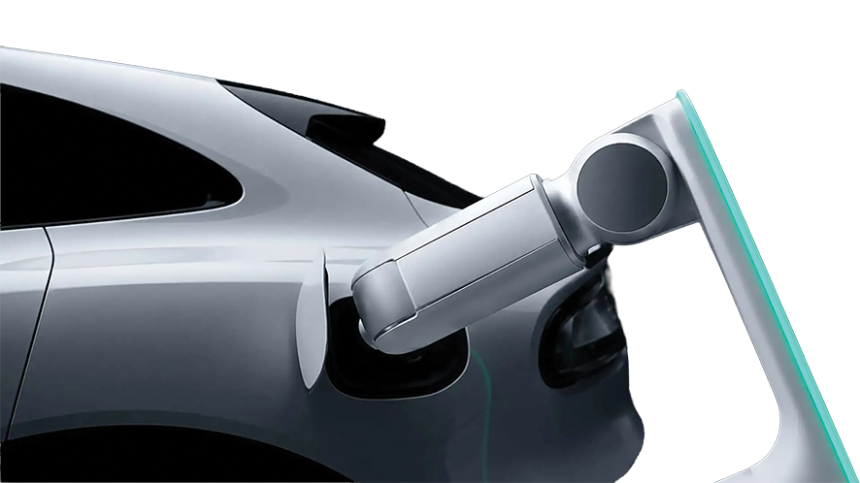
Xiaomi has unveiled a home charging robot that performs the entire charging process autonomously. Once a compatible vehicle is parked, the compact robotic arm extends from its wall-mounted enclosure, locates the charging port and inserts the connector. Once charging is complete, the system automatically disconnects and retracts. The technology is expected to be available in China during the fourth quarter of 2026, representing one of the first commercially targeted robotic charging systems for residential use.
The system inevitably draws comparisons with Tesla’s “metal snake” charging arm, first demonstrated in 2015 but never commercialised. While Tesla has since shifted its focus towards wireless charging for future autonomous vehicles, Xiaomi has adopted a more conventional conductive charging approach, automating the connection process rather than replacing it entirely.
This approach offers several advantages. Automated conductive charging retains the high charging efficiencies of conventional plug-in systems while eliminating user interaction. It also avoids many of the efficiency losses, packaging challenges and infrastructure costs associated with inductive wireless charging.
INFRASTRUCTURE INTEGRATION
Hyundai Motor Group has been pursuing a similar objective through its Automatic Charging Robot (ACR), although with a greater emphasis on public charging infrastructure and accessibility. Its single-arm robotic system uses three-dimensional camera-based artificial intelligence to identify the vehicle’s charging port before opening the charge flap, inserting the connector and disconnecting the cable when charging is complete.
Unlike fixed home charging systems, Hyundai’s robot has been engineered to accommodate varying parking positions and environmental conditions. The company has developed weather-resistant hardware capable of operating outdoors while compensating for manufacturing tolerances, vehicle positioning and charging connector alignment.
Reliable automated charging requires the integration of computer vision, force sensing and motion control capable of aligning high-power connectors with millimetre-level accuracy. Small variations in parking position, vehicle suspension movement or connector orientation can all influence insertion forces, requiring sophisticated control algorithms to prevent connector damage while maintaining reliable operation.
THE FUTURE OF ROBOTIC CHARGING
These developments are particularly relevant as automated parking and autonomous driving technologies continue to mature. A vehicle capable of parking itself could, in future, also charge itself without any driver involvement. Fleet operators could benefit from reduced labour requirements, while robot-assisted charging could significantly improve accessibility for drivers with reduced mobility who may find heavy charging cables difficult to handle.
For commercial vehicle manufacturers, robotic charging could also support depot automation. Buses, delivery vans and autonomous logistics vehicles operating on predictable schedules could connect automatically to conductive chargers without requiring expensive pantograph infrastructure or manual intervention, improving asset utilisation while simplifying overnight charging operations.
However, challenges still remain before widespread deployment. Robotic systems introduce additional hardware costs and mechanical complexity, while interoperability between different vehicle charging port locations and connector standards will require careful consideration. Standardisation will be essential if robotic charging is to move beyond manufacturer-specific ecosystems.