A wave of new initiatives are creating additional opportunities for engineers and technicians to upskill and future-proof their careers
As the transport sector accelerates towards a future driven by decarbonisation, digitalisation and resilience, workforce development has become a critical enabler
A wave of new initiatives across hydrogen, electric vehicle (EV) infrastructure, rail technology, digital twins, and cybersecurity training are creating additional opportunities for engineers and technicians to upskill and future-proof their careers. Here, International Transport Manufacturer summarises some of the latest announcements.
TALENT IN HYDROGEN
Hydrogen UK has opened nominations for the 2026 Hydrogen UK Awards, an initiative designed to spotlight innovation, thought leadership, and workforce development in the hydrogen economy. As part of the Hydrogen UK Annual Conference and Awards (Birmingham NCC, 10–11 March 2026), the programme includes a dedicated “Future Hydrogen Leader” category, aimed at recognising emerging professionals and young engineers making an impact in hydrogen deployment.
Other categories – such as Hydrogen for Transport, Innovation Project, and Industrial Application – serve to highlight the growing skills demand in applying hydrogen technology across multiple sectors. Free and open to individuals, companies and institutions, the awards provide a national platform to celebrate and promote excellence in hydrogen-related disciplines.
INFRASTRUCTURE INVESTMENT
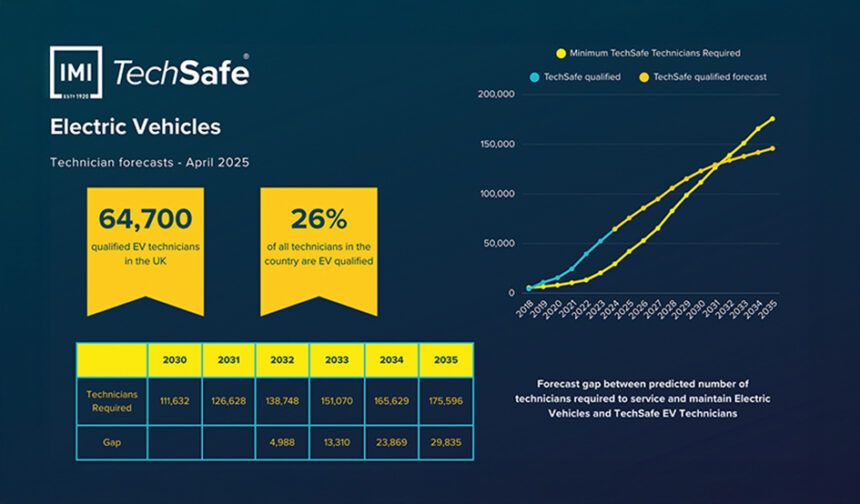
The UK government’s £63 million investment in EV infrastructure, announced earlier this year, was welcomed by industry. However, the Institute of the Motor Industry (IMI) has warned that the real-world impact of this funding may be limited unless urgent action is taken to address the growing EV technician shortfall.
“Only around 26% of UK vehicle technicians currently hold an EV qualification,” said Sarah Sillars OBE, Interim CEO at the IMI. “As the EV parc grows, the postcode lottery of access to qualified servicing professionals is going to worsen.”
The IMI projects that the technician shortfall could exceed 29,000 by 2035, threatening to undermine adoption and consumer confidence. To counter this, the IMI is calling for targeted government support in training delivery and apprenticeships, and has published a workforce strategy manifesto, Driving the Future of Automotive Professionals. It includes plans to enhance recruitment pipelines, offer modular upskilling, and establish career progression frameworks to retain skilled workers.
RAIL INNOVATION
In June 2025, construction began on the Derbyshire Rail Industry Innovation Vehicle (DRIIVe), a major new rail training and R&D centre being developed next to the historic Barrow Hill Roundhouse near Chesterfield.
Scheduled to open in 2026, DRIIVe will feature:
- Classroom and training areas for level 2 through postgraduate education
- A commercial workshop for industry R&D
- A digital laboratory for advanced simulation and prototyping
- On-site presence for rail supply chain businesses
Funded through the Staveley Town Deal, with contributions from local and regional authorities, DRIIVe aims to deliver a full pipeline of rail engineering talent.
“This exciting project will not only create jobs and skills opportunities but also inspire the next generation of rail professionals,” said Claire Ward, Mayor of the East Midlands. Mervyn Allcock, Barrow Hill Roundhouse Manager, added: “We’re already seeing interest from the sector—this facility will set us apart as a hub of innovation.”
CYBERSECURITY TRAINING
With transport systems becoming increasingly digitised and interconnected, the CYRUS project has launched a new suite of free cybersecurity training courses tailored for the transport and manufacturing industries. Available online until October 2025, these short courses are designed for both technical and non-technical personnel, ranging from engineers and operators to HR and finance professionals.
Developed by Deep Blue and a consortium of EU partners including UIC, the training modules are structured across three levels (beginner, skilled, expert) and take under four hours each to complete. Learners can expect:
- Real-world case studies
- Interactive e-learning content
- Certificates of Completion or Excellence
- Optional live webinars with cybersecurity professionals
“Cybersecurity is no longer just a technical issue – it’s a business-critical skillset across all levels of an organisation,” said Alessia Golfetti, CYRUS Project Coordinator. “With AI and automation increasing attack surfaces, building human resilience is as important as investing in secure systems.”
DIGITAL TWINS
The newly launched UK Digital Twin Centre in Belfast represents a major step forward in immersive, systems-level training and research. Operated by Digital Catapult and funded by the Belfast Region City Deal and Innovate UK, the facility is equipped with a 360-degree immersive space, cyber-physical laboratories, and testing environments for simulated industrial scenarios.
The centre supports engineering teams from aerospace, maritime, and defence sectors, helping them develop and deploy digital twins of assets, processes, and infrastructure.
A six-month Accelerator Programme – now open for expressions of interest – offers Innovate UK-funded collaboration opportunities between tech SMEs and industry partners. Participants receive mentorship, workshops, and tools to develop proofs of concept using enabling technologies like IoT, data integration, and virtual simulation.
“Digital twins are unlocking real business value, from optimising design to enhancing supply chain resilience,” said Susan Bowen, CEO of Digital Catapult. “The new centre offers a national resource to demystify and democratise access to these technologies.”
The combined effect of these initiatives is a growing ecosystem of opportunity. Each programme – from hydrogen recognition awards and rail engineering hubs to immersive digital twin training – serves a critical function in preparing the UK transport workforce for the next decade.