LMI Technologies’ Annika Meininger discusses the engineering case for open architecture.
Artificial intelligence (AI) is becoming an increasingly important component of industrial machine vision. As AI moves into production inspection, vision engineers face a fundamental architecture decision: how tightly should AI model development be coupled to the hardware and software responsible for executing the inspection?
Closed vision ecosystems can simplify initial deployment but may restrict engineers to vendor-specific development tools and workflows. Custom PC architectures provide greater flexibility but can introduce significant integration requirements across cameras, GPUs, inference engines, vision libraries, communications, and visualisation.
The challenge is that these technologies operate on different lifecycles. Industrial vision hardware may remain in production for years, while AI frameworks, model architectures, and training environments evolve much more rapidly. A flexible architecture therefore needs to separate AI model development from production execution.
DECOUPLING DEVELOPMENT FROM EXECUTION
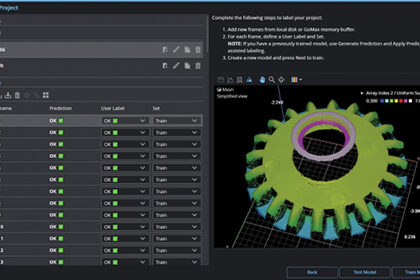
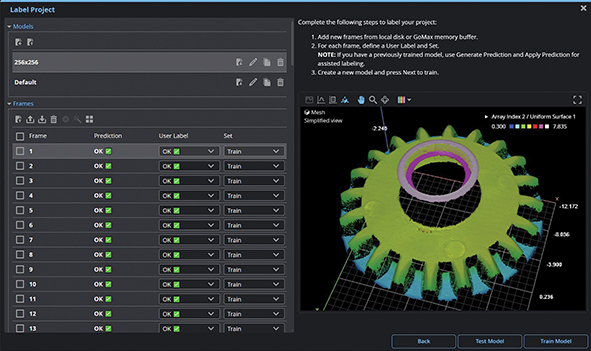
Bring Your Own Model (BYOM), introduced in GoPxL 1.6, applies this principle across 2D and 3D inspection applications. Engineers can import compatible YOLO models developed outside the GoPxL training environment, including Ultralytics models such as YOLO 26. Models can be developed using Roboflow or other preferred AI frameworks and training infrastructure, allowing engineering teams to retain control over data preparation, labelling, training, and model selection.
Once trained, imported models can be incorporated directly into a GoPxL inspection pipeline alongside traditional vision tools. This creates an important architectural distinction: the production vision environment can execute the model without dictating how that model is developed.
FLEXIBLE EDGE DEPLOYMENT FOR 2D AND 3D
GoPxL extends this flexibility to deployment. Imported models can run on PC or GoMax acceleration without requiring a GoPxL Pro Tools runtime license, using open-source inference tools that can also be customised for application-specific requirements.
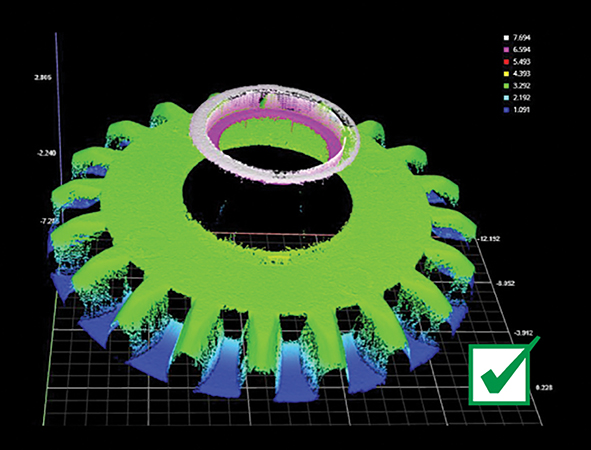
For 2D applications, the Image Inference Tool executes imported models on image data, including directly on supported Gocator 2D Smart Cameras. For 3D applications, the Surface Inference Tool applies imported models to surface data using PC or GoMax compute. Surface inference is not executed onboard Gocator 3D sensors. This provides a common approach to BYOM across both 2D and 3D inspection while allowing compute resources to be selected according to application requirements.
INTEGRATING AI INTO THE INSPECTION PIPELINE
A production vision system must do more than execute inference. It must acquire and pre-process data, perform measurements, generate decisions, communicate with factory equipment, and provide visualisation and diagnostics.
Within GoPxL, imported AI models can operate alongside traditional rules-based tools in the same inspection pipeline. AI can address complex classification or visual variation, while deterministic tools handle geometric measurement, tolerances, and decision logic.
The engineering value of open edge AI is therefore not simply greater model choice. It is the ability to develop models using the tools best suited to the application, deploy them across a scalable industrial vision architecture, and integrate AI with established machine vision workflows without building a custom software stack around every inspection.
As AI technologies continue to evolve, this separation helps keep the production architecture stable while allowing the AI layer to advance independently.
Annika Meininger is at LMI Technologies.
Read the October issue of International Design Engineer magazine here, or visit our magazine archive for all our recent publications.